

 Interest Rate Hedged
 This links to a pdf file
This link opens a new window
Interest Rate Hedged
This links to a pdf file
This link opens a new window
Interest Rate Hedged

 This links to a pdf fileThis link opens a new window

Key Takeaways
After a decade of historically low interest rates, investors are now operating in a very different environment. Yields are meaningfully higher than they were for much of the post-financial-crisis period, and strategies that worked well during a sustained bond bull market may not be as effective. For many investors, the challenge is not simply predicting whether rates will rise or fall next, but understanding how to build portfolios that can better withstand a range of interest rate outcomes.
This guide focuses on practical strategies that may help you:
-
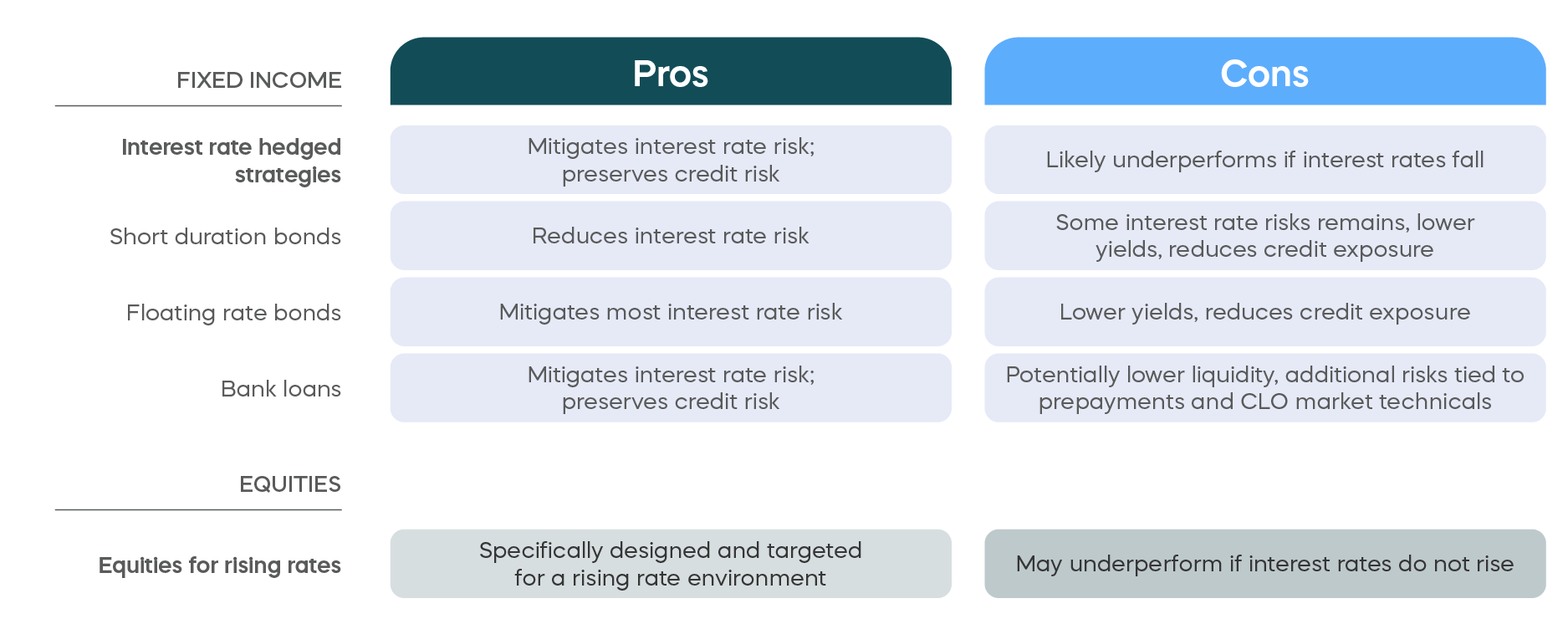
Defend fixed income portfolios against rising rates. Traditional rising-rate approaches—short duration, floating-rate bonds, bank loans and Treasury Inflation-Protected Securities (TIPS) —can be used to reduce some rate sensitivity, but they can also limit credit exposure or introduce other trade-offs. Interest rate hedged bond strategies may offer a more targeted alternative.
- Use equity strategies to go on offense. Stocks historically fare better than bonds when interest rates rise, but stock selection matters. A strategy focused on sectors and companies most correlated with rising rates may help investors target equity opportunities when rates move higher.
No single strategy is right for every investor. The best approach is to evaluate a broad range of tools and choose the combination that fits an investor's objectives, risk tolerance and market outlook. ProShares' lineup of rising-rate strategies may provide a convenient place to start.
Comparing rising rate strategies
Explore ETF Strategies for Rising Rates
How can fixed income strategies help defend against rising rates?
Bond basics: How do rising rates affect bonds?
Bonds lose market value when interest rates rise. Most bonds pay fixed coupons, the annual interest rate paid by a bond issuer to an investor, expressed as a percentage of the bond's face value.
When interest rates rise, bonds lose market value. Most bonds pay fixed coupons. If interest rates rise, the only way that a fixed coupon can equate to a higher interest rate is if the buyer pays less for the bond. How much less? A bond’s duration is the measure of its price sensitivity to interest rate changes.
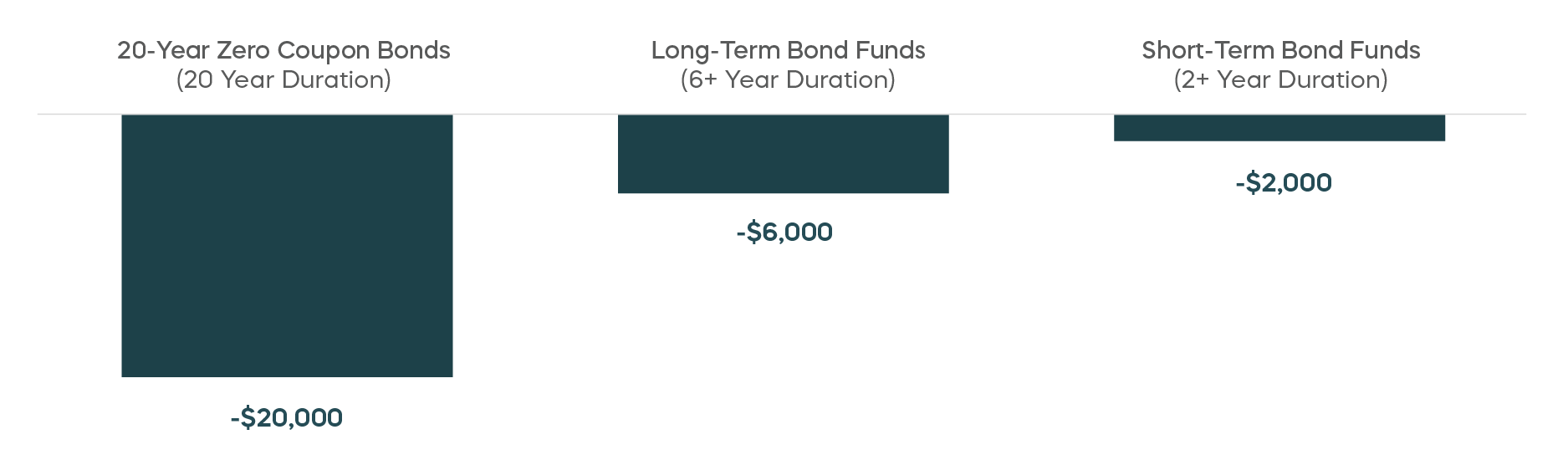
Simply multiply a change in interest rates by a bond’s duration and you have a solid estimate of its change in price. Interest rates go up 50bps. A bond with a duration of 10 will lose approximately 5% of its value. Duration is a function of maturity. The longer the maturity of a bond, the longer its duration. The price of a longer-maturity bond is more sensitive to a change in interest rates than that of a shorter maturity bond (all else being equal). The following illustrates how much a $100,000 bond portfolio could decline from a 1% rise in U.S. interest rates.
When interest rates rise, bond portfolios decline
Comparing rising rate strategies
Bond basics: Credit risk vs. interest rate risk
Credit risk measures the possibility a borrower may default or that investors demand more compensation for that risk. Interest rate risk measures how bond prices respond when Treasury rates, inflation expectations or real yields change—even when default risk is minimal.
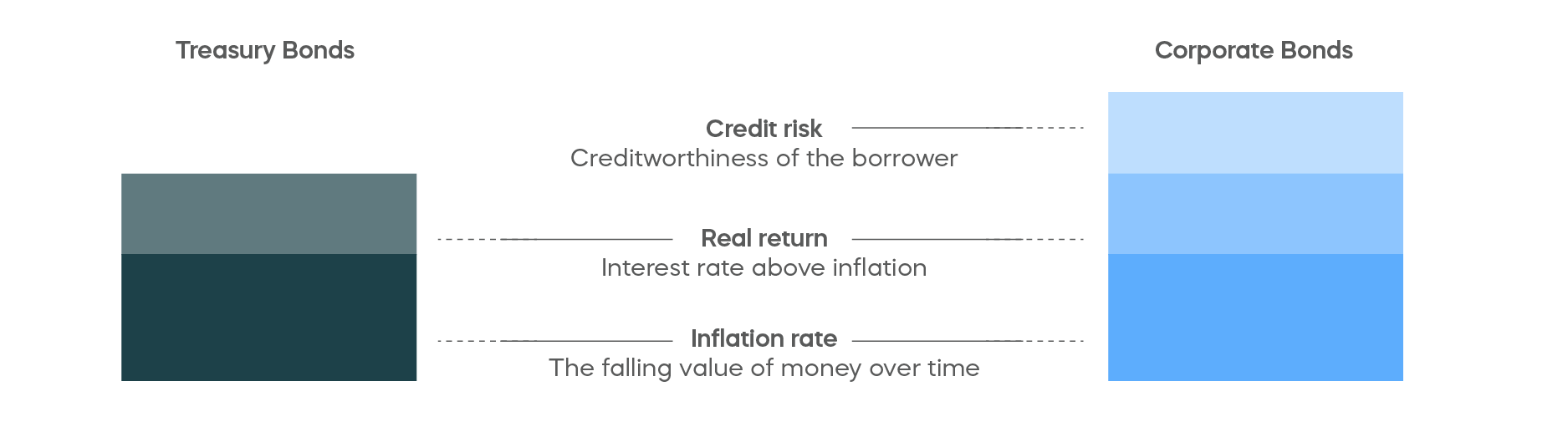
Some consider a U.S. Treasury bond to have virtually no default risk. Its interest rate—known as a “risk-free rate”—is solely a compensation for giving up money for a period of time. Even without default risk, investors demand a return for lending their money. That return is composed of an inflation component and a “real return” typically over and above inflation. A 10-Year U.S. Treasury bond yielding 4% when inflation is 2% has a 2% “real return.”
While a U.S. Treasury bond has virtually no default risk, it is far from riskless. Higher inflation could push yields higher and prices lower. Lower inflation could push yields lower and prices higher. And real returns can shift as well—interest rates can rise without additional inflation. For example, quantitative easing can force real returns lower, and quantitative tightening can force real yields higher.
Corporate bonds have default risk. Companies can go bankrupt. Investors demand an interest rate that’s higher than that on a Treasury bond. That “extra” yield is called a credit spread and is a function of the creditworthiness of the borrower: wider spreads for companies with a greater risk of default and narrower spreads for companies with a lower risk of default. A corporate bond, therefore, has an additional source of risk (and return). The Treasury rate component can go up or down, but spreads can widen or narrow based on either changes in a company’s creditworthiness or the market’s pricing of risk.
Comparing Sources of Return and Risk
Inflation typically rises when the economy improves. Therefore, when the economy improves, U.S. Treasury rates often rise, and prices fall. But an improving economy can have two contradictory effects on corporate bond returns. Rising Treasury rates reduce bond prices. But there’s another, positive effect. Because companies often thrive in a booming economy, investors don’t demand as much of a premium for investing in corporate bonds when growth accelerates. Credit spreads—that is, the difference in the interest rates between corporate bonds and Treasurys—can shrink. In fact, credit spreads for both investment-grade and high-yield bonds have been negatively correlated with interest rates. Corporate bonds have often outperformed Treasury bonds in rising rate periods because the tightening of credit spreads offsets some of the rise in Treasury rates.
Rising rates can have a contradictory effect on corporate bond returns
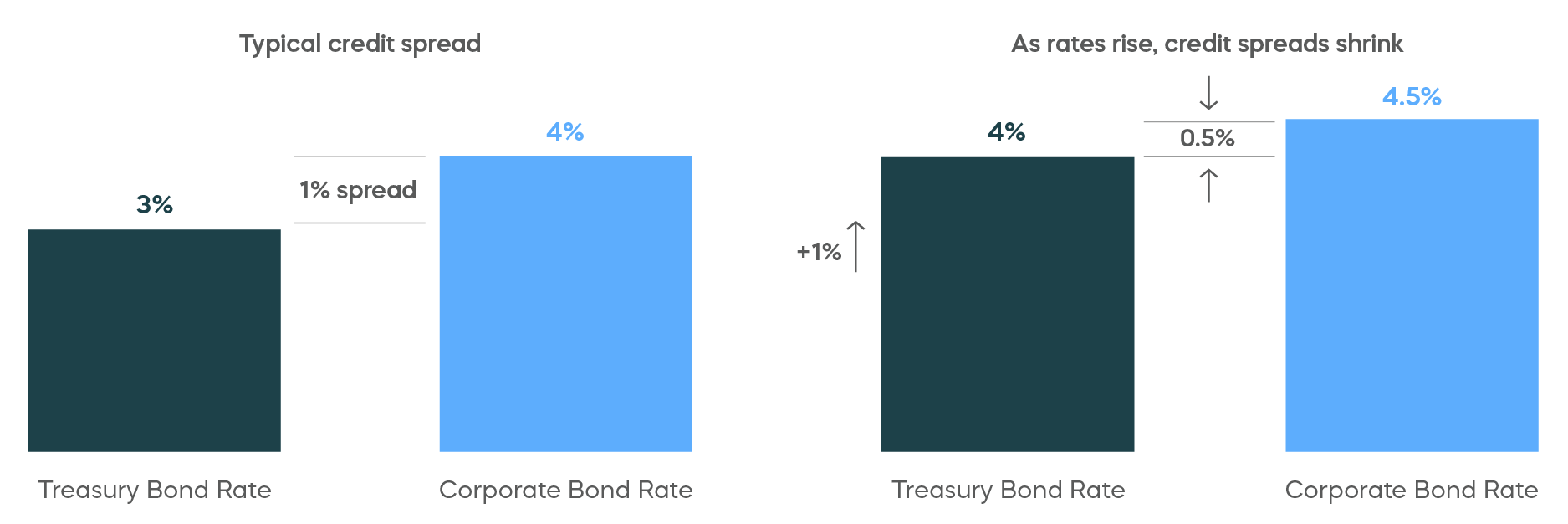
Historically, that’s meant that corporate bonds—investment grade and high yield—have outperformed Treasury bonds in rising rate periods because the tightening of credit spreads can offset some of the rise in Treasury rates.
Which fixed income strategies can help in rising-rate environments
Basic bond math is at the core of most bond strategies for rising rates. Shortening duration limits the potential damage if rates rise. A bond with a duration of five has roughly half the exposure to rising rates as a bond with a duration of 10. This is a straightforward approach for U.S. Treasurys. And for the very low-risk portion of an investment portfolio where low yields and returns are par for the course—think cash or near cash—short-duration Treasuries may be a prudent choice. There’s more to the story for corporate bonds.
The benefits and drawbacks of popular strategies
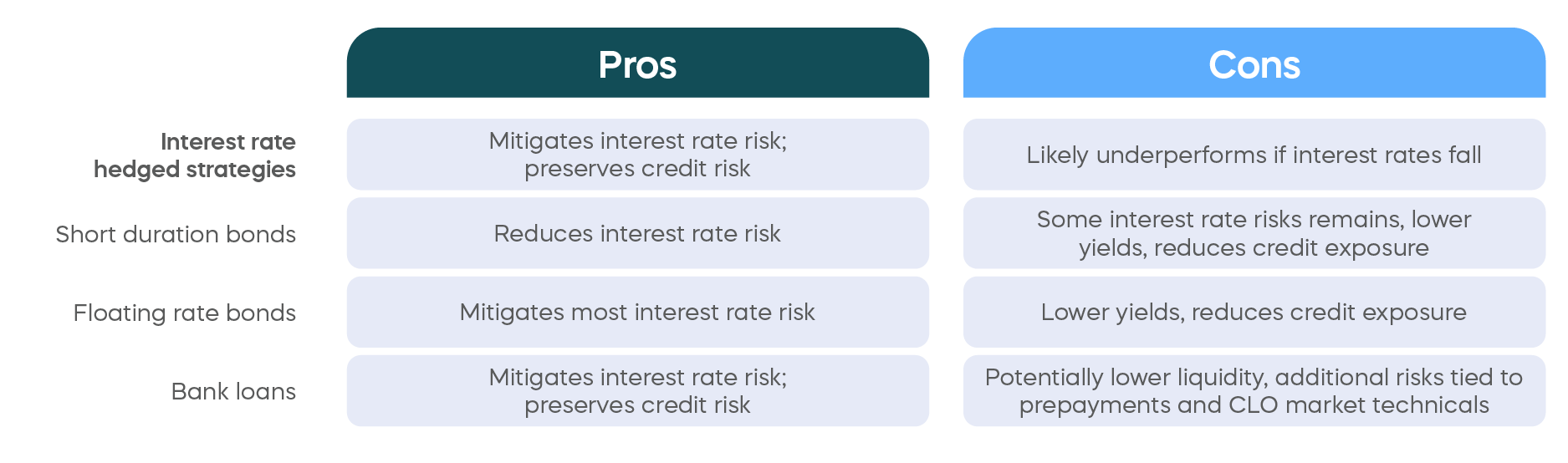
Comparing strategies: hedged, short duration, floating rate and bank loans
Interest rate hedged bonds: Mitigate interest rate risk, while preserving credit exposure
What is an interest rate hedged bond strategy?
An interest rate hedged bond strategy typically combines corporate bond exposure with hedges designed to mitigate the impact of rising Treasury rates.
As we mentioned above, credit spreads often compress or tighten in a rising rate environment. Back to simple bond math: Tightening credit spreads push corporate bond prices up. As a result, investors concerned about rising interest rates might consider a strategy that seeks to mitigate interest rate risk during periods of rising rates while still potentially benefiting from improving credit spreads. That runs counter to the common assumption that short-duration or floating-rate strategies provide the best protection in a rising rate environment. These strategies do reduce interest rate risk, but they also limit credit exposure. They may help dampen the negative effects of rising rates but at the cost of limiting the opportunity to profit from credit spreads. Interest rate hedged bond strategies are structured to mitigate interest rate risk while retaining full exposure to credit risk. It’s a combination that may be well-suited to a rising interest rate environment.
How interest rate hedged bond strategies work
Interest rate hedged bond strategies typically invest in portfolios of investment-grade or high-yield bonds and include built-in hedges to alleviate the impact of rising Treasury rates. Since the hedges are specifically targeted at rising Treasury rates, the strategies retain the full exposure to credit risk as a primary source of return.
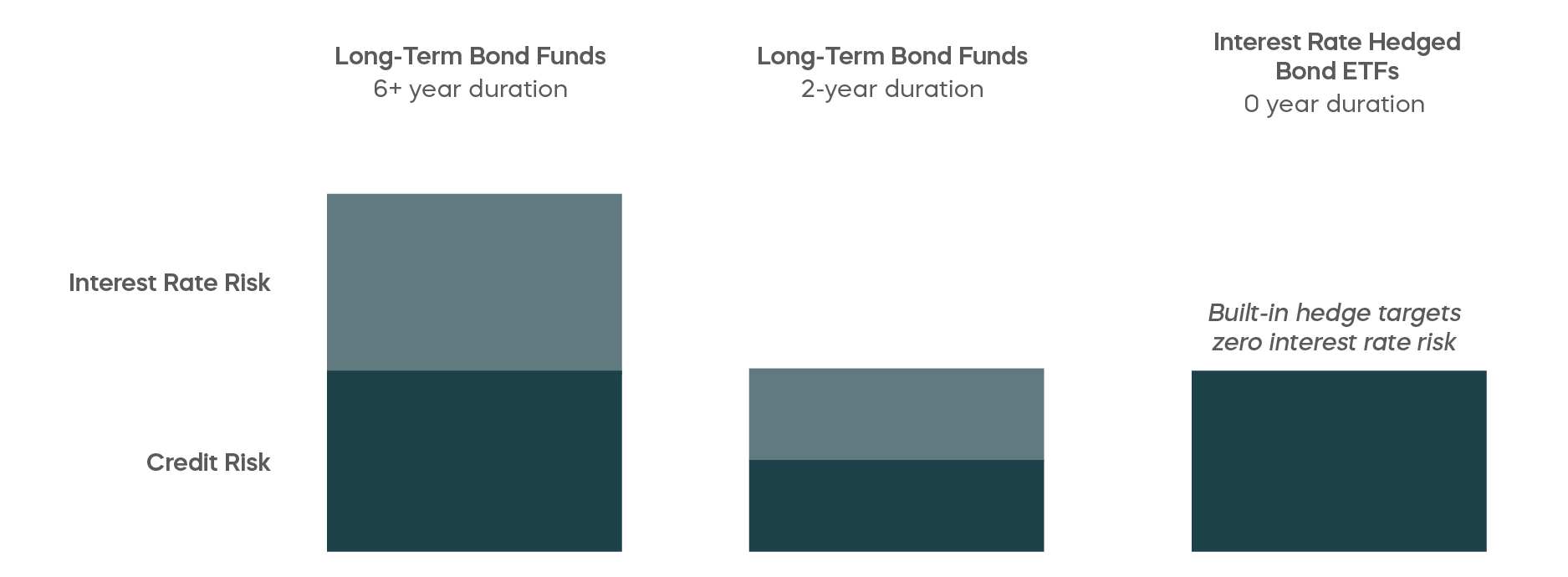
In the illustration below, you can see how a short duration bond strategy can reduce interest rate risk, but does not eliminate it. Meanwhile, interest rate hedged bond ETFs can mitigate interest rate risk.
The Fixed income You Want Without the Interest Rate Risk
Compare Rising Rate Strategies
Short-duration bond strategies reduce interest rate risk but do not eliminate it. And they limit exposure to credit risk. By mitigating interest rate risk and preserving credit risk, interest rate hedged bond strategies—both investment grade and high yield—have outperformed in rising rate environments.
Interest Rate Hedging versus Short Duration Bond Strategies
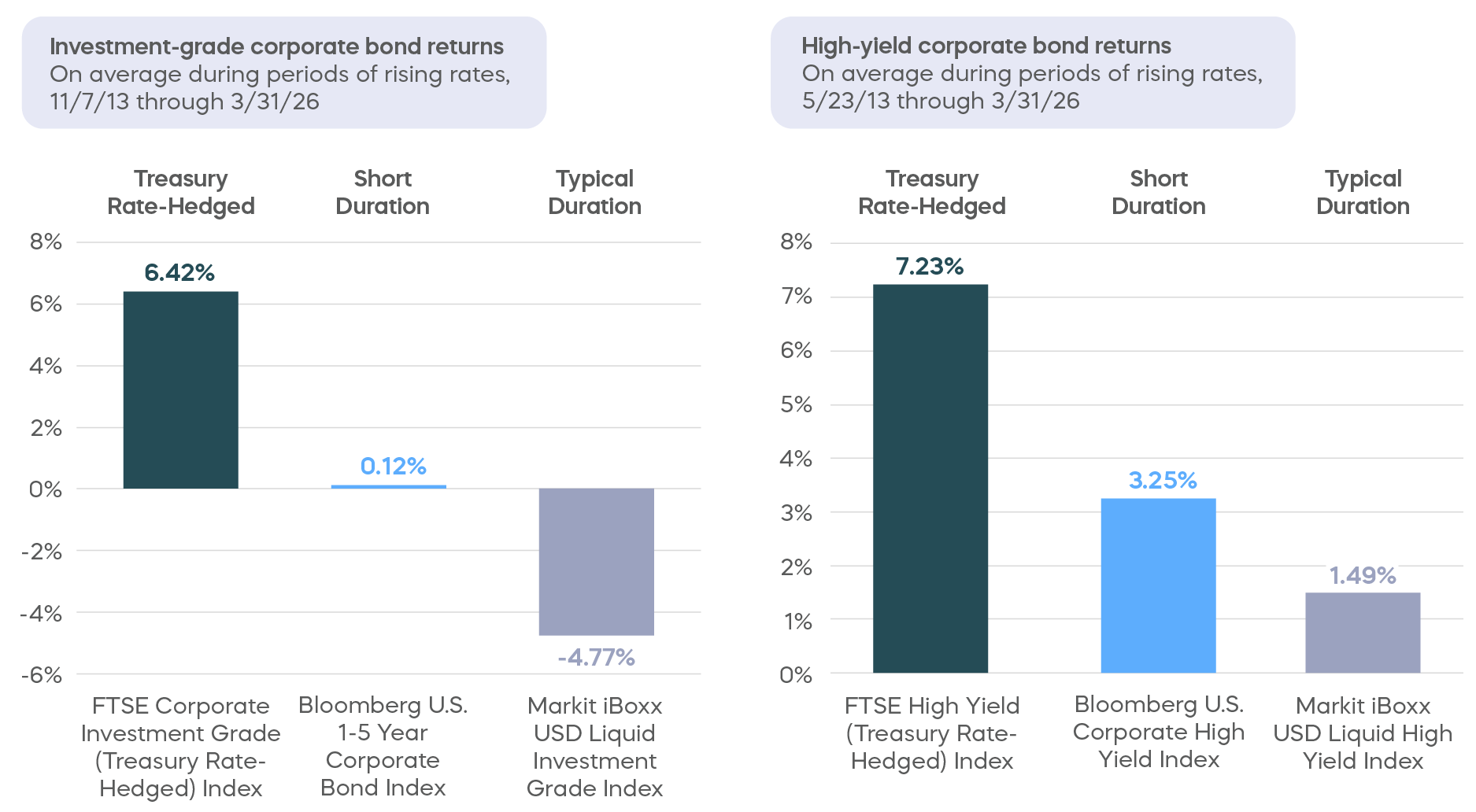
Source: Bloomberg. Starting dates reflect available data since ProShares launched ETFs tracking the respective interest rate hedged indexes. Index returns are for illustrative purposes only and do not reflect any management fees, transaction costs or expenses. Indexes are unmanaged, and one cannot invest directly in an index. Past performance does not guarantee future results.
Standardized performance as of 6/30/26. ProShares Investment Grade—Interest Rate Hedged ETF (IGHG): 1-year 5.41% (NAV) | 5.23% (Market Price), 5-year 5.11% (NAV) | 5.12% (Market Price), 10-year 4.82% (NAV) | 4.87% (Market Price), since inception 11/5/13 3.74% (NAV) | 3.74% (Market Price). ProShares High Yield—Interest Rate Hedged ETF (HYHG): 1-year 6.79% (NAV) | 7.16% (Market Price), 5-year 6.88% (NAV) | 6.93% (Market Price), 10-year 6.24% (NAV) | 6.24% (Market Price), since inception 5/21/13 4.21% (NAV) | 4.24% (Market Price). The performance quoted represents past performance and does not guarantee future results. Investment return and principal value of an investment will fluctuate so that an investor's shares, when sold or redeemed, may be worth more or less than the original cost. Shares are bought and sold at market price (not NAV) and are not individually redeemed from the fund. Market price returns are based upon the midpoint of the bid/ask spread at 4:00 p.m. ET (when NAV is normally determined for most funds). Your brokerage commissions will reduce returns. Current performance may be lower or higher than the performance quoted. For standardized returns and performance data current to the most recent month end, see Performance.
Floating rate investment grade corporate bonds have interest payments that increase when Treasury rates rise. As a result, investors in these securities have minimal exposure to changes in Treasury rates. In addition, because floating-rate securities generally have short maturities, changes in credit spreads have limited (but not zero) impact on their value. Just like short-duration corporate bonds, these securities reduce exposure to interest rates and credit spreads simultaneously. The combination of minimal interest rate exposure and reduced credit exposure can limit an investor’s potential returns from floating-rate bonds.
Interest Rate Hedging versus Floating Rate
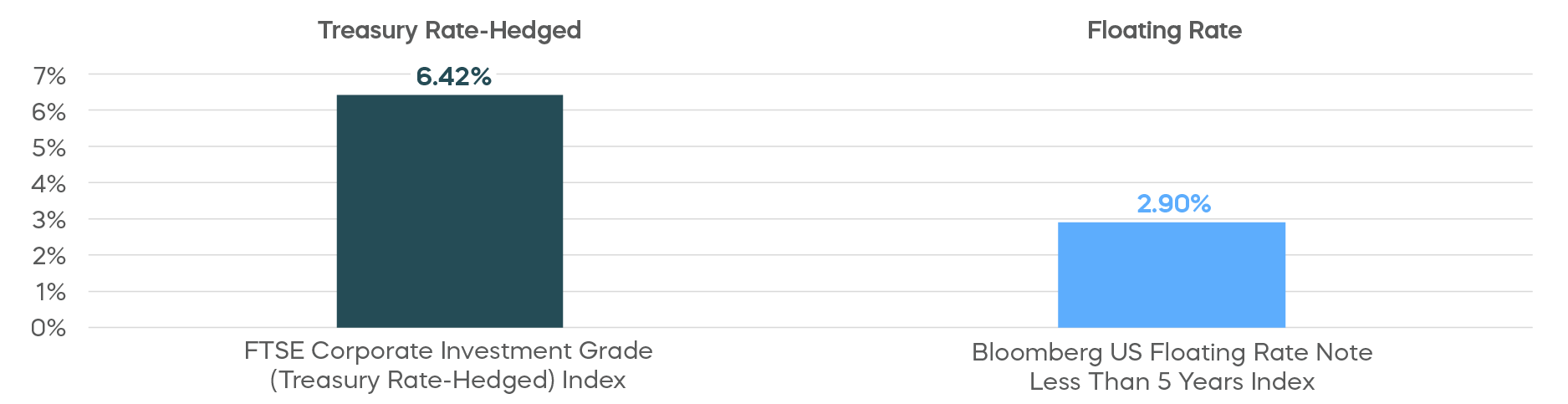
Source: Bloomberg. Returns, on average during periods of rising rates, 11/7/13, through 3/31/26. Starting dates reflect available data since ProShares launched ETFs tracking the respective interest rate hedged indexes. Index returns are for illustrative purposes only and do not reflect any management fees, transaction costs or expenses. Indexes are unmanaged, and one cannot invest directly in an index. Past performance does not guarantee future results.
Bank loans are leveraged credit with floating coupon payments tied to short-term interest rates. Because they often have longer maturities (and lower credit quality) than floating-rate securities, they are exposed to significantly more risk from changing credit spreads than floating-rate investments. Bank loans do offer some opportunity to reduce interest rate exposure while maintaining credit risk exposure. However, there are several important considerations investors should keep in mind when evaluating bank loans and bank loan strategies.
First, the market structure is different between bank loans and high yield bonds. Bonds can be bought or sold more quickly than loans, with most trades settling within two days. On the other hand, even the more liquid broadly syndicated loans may take seven days or more to settle. In addition, CLO (collateralized loan obligations) plays an outsized role in the loan market, where approximately two-thirds of investor demand for loans takes the form of CLOs. Dynamics of the CLO market, such as CLO formation, reprice, or reset, can all have a significant indirect impact on bank loan performance independent of the underlying credit fundamentals.
Call provisions are another consideration. Bank loans can be “called at par,” which means the issuer may be able to pay back the loan at face value. That limits the potential for price appreciation for investors. Any time a loan trades above par, it is likely to be called, leaving investors with cash to reinvest. Although high yield bonds can also be callable, they often include more formal call protections.
Finally, bank loans and high yield bonds also differ in their underlying credit exposure. Loans are often used more in sponsor-backed transactions, whereas bonds may be issued by a different mix of borrower profiles. For instance, the loan market has had relatively greater exposure to software borrowers, while the high yield market has larger weights in communications and energy.
Interest Rate Hedging versus Bank Loans
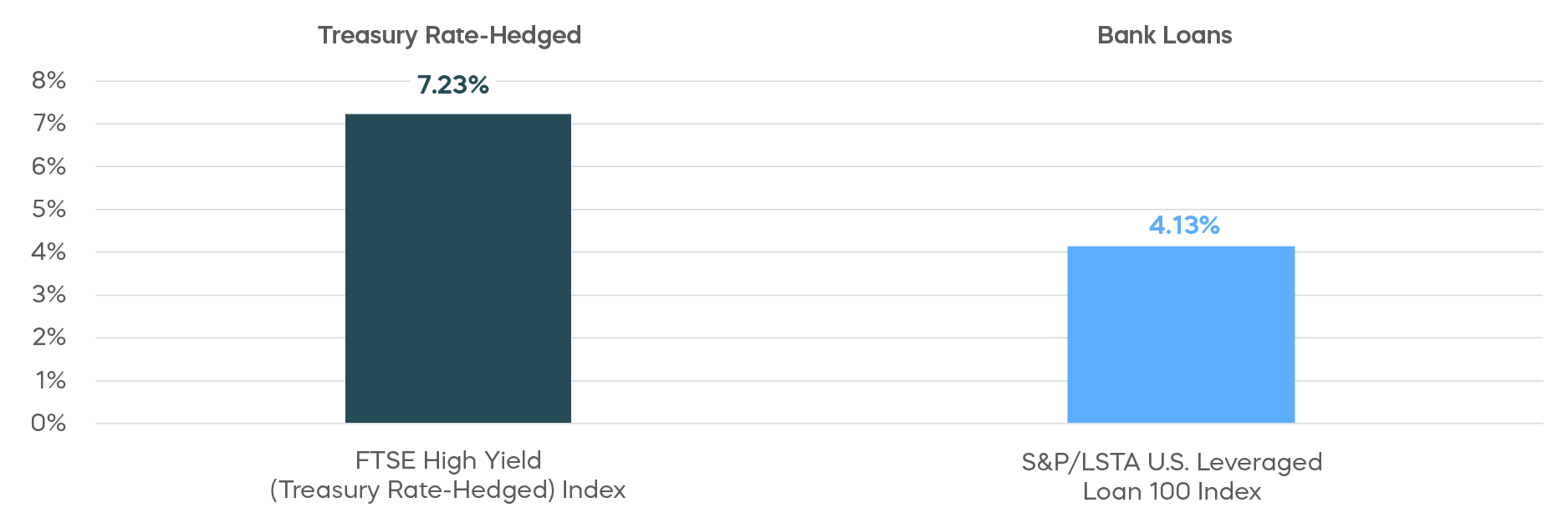
Source: Bloomberg. Returns, on average during periods of rising rates, 5/26/13 through 3/31/26. Starting dates reflect available data since ProShares launched ETFs tracking the respective interest rate hedged indexes. Index returns are for illustrative purposes only and do not reflect any management fees, transaction costs or expenses. Indexes are unmanaged, and one cannot invest directly in an index. Past performance does not guarantee future results.
Are TIPS a hedge against rising interest rates?
TIPS can help protect against rising inflation expectations, but they can still lose value if real interest rates rise.
As of the end of May 2026, the Bloomberg index for Treasury Inflation Protected Securities (known as TIPS) has a duration of 6.6 years. That means if U.S. Treasury rates rise 1%, the price of TIPS could fall 6.6%. You may be thinking to yourself, “Wait. I thought TIPS protected investors from rising interest rates. Don’t they?” The short answer is “Not quite.”
TIPS can help protect investors from rising inflation expectations, not just inflation itself, and not specifically from rising interest rates. Inflation expectations can certainly rise when interest rates rise, and that’s why, as the adjacent chart shows, TIPS have historically outperformed regular Treasuries when rates have risen. However, the Treasury Rate-Hedged Index (based on the FTSE Corporate Investment Grade Index) has performed even better, because interest rates can rise even if inflation expectations don’t.
Therefore, TIPS can be viewed as a way for investors to own real interest rate exposure while reducing the risk of rising inflation expectations. While this structure may help protect purchasing power over time, TIPS can still underperform when real interest rates rise, particularly for longer-duration TIPS.
Interest Rate Hedging versus TIPS
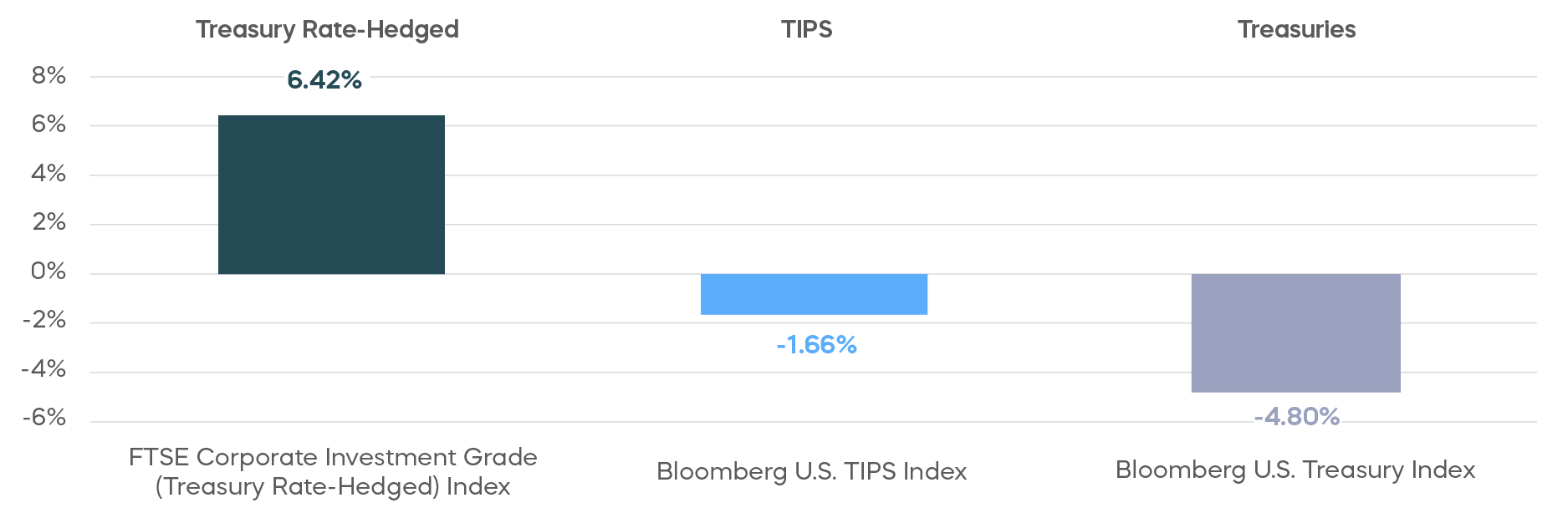
Source: Bloomberg. Returns, on average during periods of rising rates, 11/7/13 through 3/31/26. Starting dates reflect available data since ProShares launched ETFs tracking the respective interest rate hedged indexes. Index returns are for illustrative purposes only and do not reflect any management fees, transaction costs or expenses. Indexes are unmanaged, and one cannot invest directly in an index. Past performance does not guarantee future results.
Rising rates and stocks: equity strategies to go on offense
Why Equities Can Respond Differently Than Bonds
Stocks vs. bonds when rates rise
Fixed-coupon bonds face direct price pressure when rates rise. Stocks have more ways to adapt because earnings, dividends and cash flow can grow—especially when rising rates are tied to stronger economic activity.
When interest rates rise, fixed-coupon bonds face price pressure. Stocks have more potential offsets. Earnings, dividends and cash flow can grow, and stronger economic growth and robust corporate performance have driven solid performance from stocks even with the tightening of credit spreads in a rising rate environment.
Still, not all stocks respond the same way to rising rates. Sector exposure matters. Financials have historically benefited when rising rates coincide with a steeper yield curve and wider net interest margins. Energy can also benefit when higher commodity prices support earnings while contributing to inflation pressure and higher rates. Therefore, a rising-rate equity strategy should target areas of the market where fundamentals may be better aligned with the forces behind higher rates.
A focused equity strategy for rising rates
The robust relationship between sector performance and rising interest rates lends itself well to a rules-based strategy. The Nasdaq Equities for Rising Rates Index targets sectors that have had the highest correlation to 10-Year U.S. Treasury yields, and within those sectors targets the stocks that have had a tendency to outperform as rates rise. By selecting both sectors and stocks that have shown the strongest positive correlation to 10-Year U.S. Treasury yields, the strategy seeks to increase equity exposure to companies more sensitive to rising rates. Since inception, the strategy has tended to outperform the S&P 500 during periods of rising 10-year yields, with its strongest relative results occurring during longer, more persistent rising-rate periods. Its exposure is also diversified across rate-sensitive sectors, including areas such as financials and energy, which may benefit from different drivers of higher rates, including stronger growth and inflation pressures. The combination has been powerful—delivering nearly double the return of the S&P 500 year-to-date through May 29th, 2026.
Some Stock Sectors Tend to Perform Better When Interest Rates Rise...
Three-year correlation of S&P 500 sectors to rising 10-year Treasury rates.
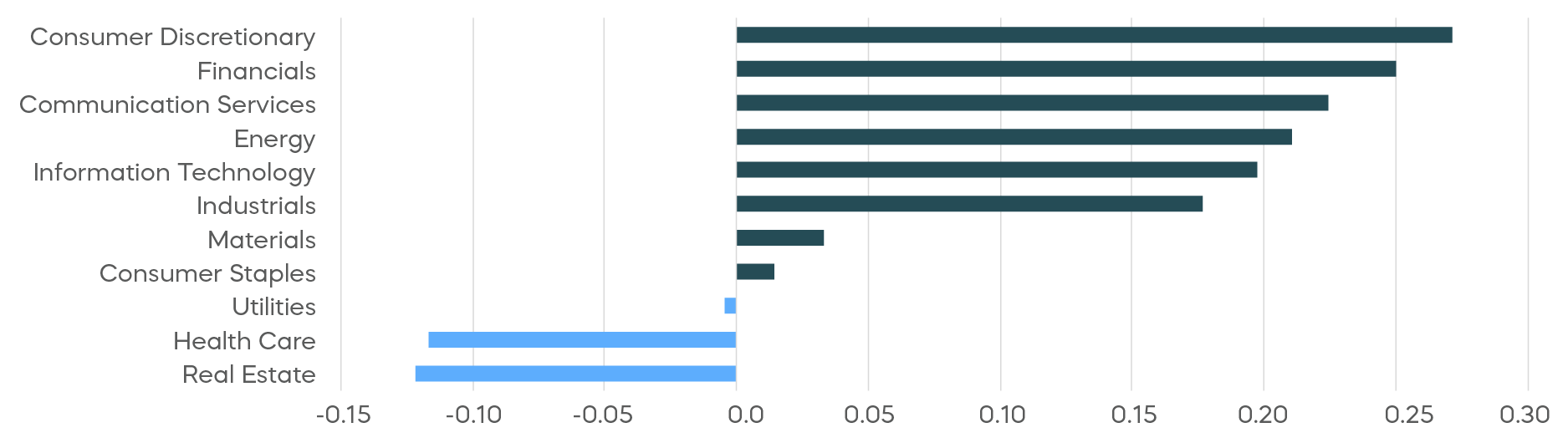
Source: Bloomberg, as of 3/31/26. Sectors based on GICS classification.
…And the Nasdaq Equities for Rising Rates Index Tilts Substantially Toward These Sectors
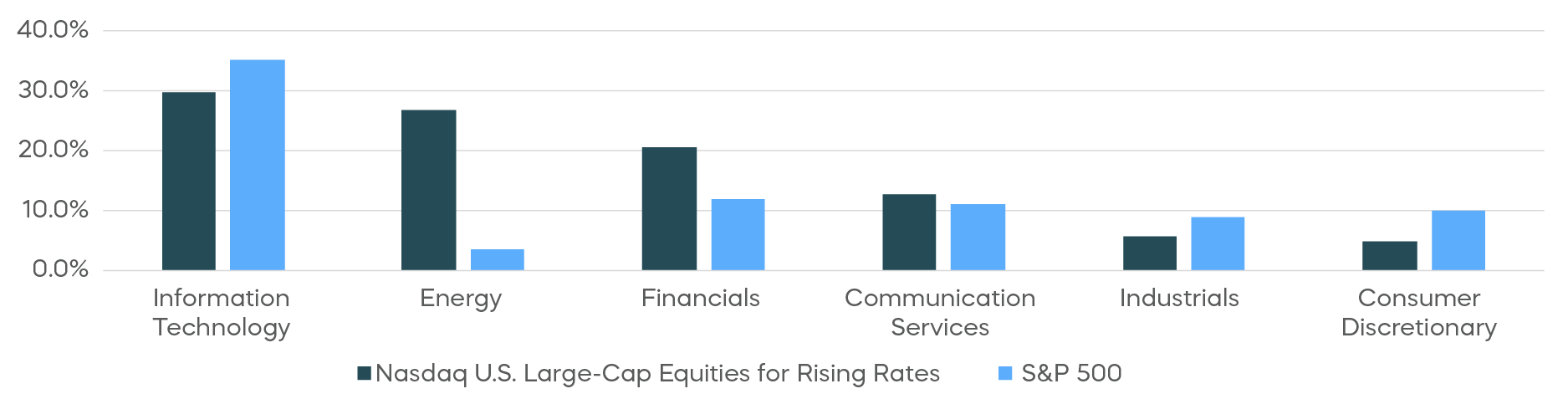
Source: Bloomberg, data from as of 4/30/26.
The Nasdaq Equities for Rising Rates Index Has Outperformed the S&P 500...
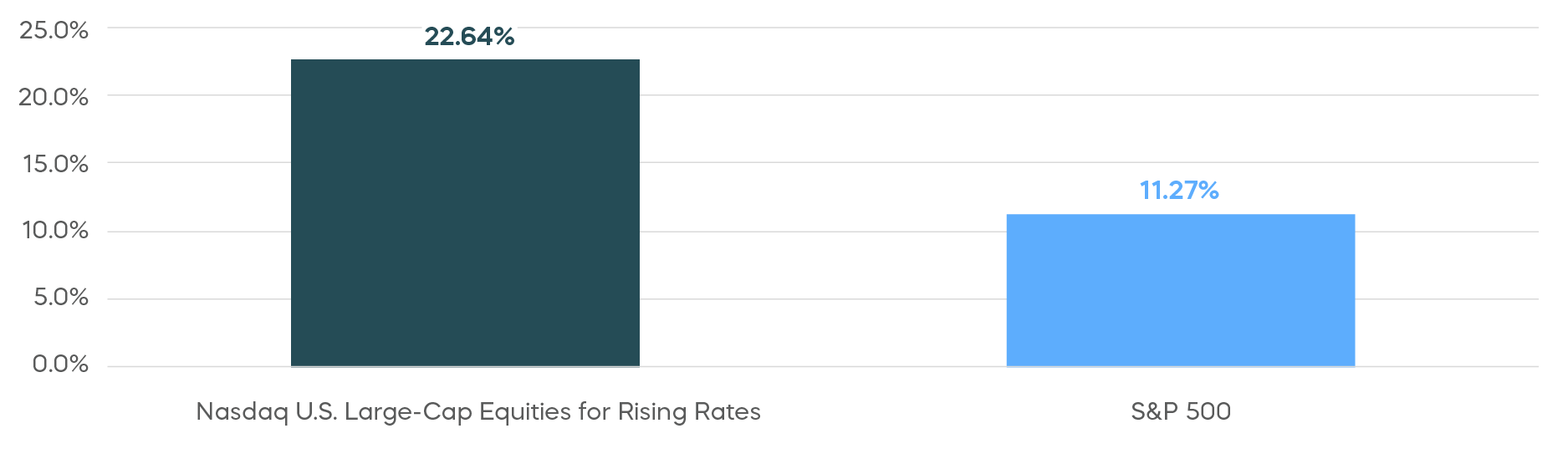
Source: Bloomberg. Performance during period of rising 10-year Treasury rates, 8/4/20 through 3/31/26.
...By Focusing On the Right Sectors—and the Right Stocks—for a Rising Rate Environment
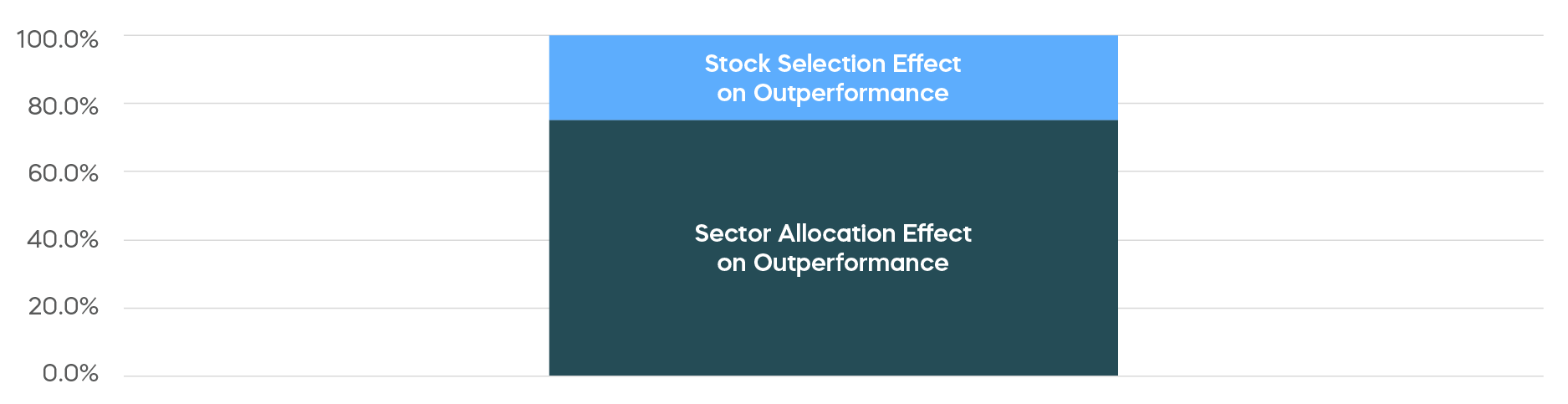
Source: FactSet. Sector allocation and stock selection components were both key contributors to the index’s performance vs. the S&P 500.
Standardized performance as of 6/30/26. ProShares Equities for Rising Rates ETF (EQRR): 1-year 39.39% (NAV) | 39.33% (Market Price), 5-year 13.21% (NAV) | 13.22% (Market Price), since inception 7/24/17 10.70% (NAV) | 10.70% (Market Price). The performance quoted represents past performance and does not guarantee future results. Investment return and principal value of an investment will fluctuate so that an investor's shares, when sold or redeemed, may be worth more or less than the original cost. Shares are bought and sold at market price (not NAV) and are not individually redeemed from the fund. Market price returns are based upon the midpoint of the bid/ask spread at 4:00 p.m. ET (when NAV is normally determined for most funds). Your brokerage commissions will reduce returns. Current performance may be lower or higher than the performance quoted. For standardized returns and performance data current to the most recent month end, visit ProShares.com.
Why choose rising rates ETFs?
ETFs: Convenient and strategic
ETFs can give investors access to targeted rising-rate strategies without requiring them to build and rebalance the underlying exposures on their own.
Bond and stock strategies designed for rising-rate environments can help investors prepare portfolios for rising interest rate environments—and even seek to profit from them. But creating those exposures can be difficult for investors on their own. ETFs can offer a more convenient implementation path, and ProShares offers a lineup of tools for rising rates, including:
-
Interest rate hedged bond ETFs, which have historically outperformed traditional bond approaches such as short duration, floating rate, bank loans and TIPS when interest rates have risen.
-
An equities for rising rates ETF, focused on sectors and stocks most correlated with rising rates, that delivered nearly double the return of the S&P 500 year-to-date through May 29, 2026.
Learn More
HYHG
High Yield - Interest Rate Hedged
Seeks investment results, before fees and expenses, that track the performance of the FTSE High Yield (Treasury Rate-Hedged) Index.
IGHG
Investment Grade - Interest Rate Hedged
Seeks investment results, before fees and expenses, that track the performance of the FTSE Corporate Investment Grade (Treasury Rate-Hedged) Index.
EQRR
Equities for Rising Rates ETF
Seeks investment results, before fees and expenses, that track the performance of the Nasdaq U.S. Large Cap Equities for Rising Rates Index.
Interest Rate Hedged
This links to a pdf file
This link opens a new window
Interest Rate Hedged
This links to a pdf fileThis link opens a new window