 Autocallable Income
 This links to a pdf file
This link opens a new window
Autocallable Income
This links to a pdf file
This link opens a new window
Autocallable Income

 This links to a pdf fileThis link opens a new window
Key Takeaways
Autocallable strategies, which can provide investors with potentially attractive income through coupon payments not primarily tied to interest rate risk, have grown in popularity. While the appeal of their typically high levels of income is straightforward, there are challenges to consider.
Investing in autocallables usually involves a complicated process of managing individual structured notes. In addition to a wide variety of structures, individual notes face reinvestment risk if the notes are called early, and they can lose principal if the underlying index declines below a predetermined level.
ProShares Autocallable Income ETFs may offer a simpler solution.
- ProShares Autocallables target high income and potentially tax-efficient distributions.
- They employ a laddered strategy that may provide a more reliable return profile and income stream, while also potentially helping to address concentration and timing risks compared to single notes.
- Their ETF structure offers a convenient way to access an autocallable strategy, and provides a liquid, single-ticker solution that removes the burden of managing individual notes.
What is an autocallable note?
Autocallable notes pay coupons periodically and return principal at maturity if the underlying index has not fallen below a certain barrier level at the time of maturity. ProShares research comparing yields and distribution rates (as of 6/30/26) shows that autocallable notes allow investors to target potentially attractive levels of income that may be higher than other income strategies.
The tradeoff in exchange for potentially higher income is the risk that a significant market downturn could result in a loss of principal. As such, it’s important to understand how autocallable strategies function in different market scenarios.
While an autocallable’s final payout is determined at maturity or an earlier call date, equity markets move every day. The sensitivity of an individual note to market movements in its underlying benchmark can depend on factors like how close it is to maturity, or how close a price movement is to a call price or a barrier (more on these below). As a result, each autocallable note can trade at a premium or discount to its par value at any time before maturity.
Broadly speaking, there are three possible payoff profiles when investing in autocallables:
- The market rises or stays flat: Here, investors receive a periodic coupon payment until maturity. Or, if the market rises to the note’s autocall level, the note is called and investors receive their final coupon payment and principal. Otherwise, the note continues to generate coupon payments and remains outstanding until maturity.
- The market declines, but remains above a note’s protective “barrier”: Barriers are predetermined price levels above which an investor’s principal is protected, even if some price volatility in the underlying index occurs. Investors receive periodic coupons until maturity if the underlying index stays in this range, and at maturity, receive the final coupon and their principal.
- The market declines below the barrier: If the underlying index has fallen below the barrier at maturity, the investor loses principal value proportionate to the decline.
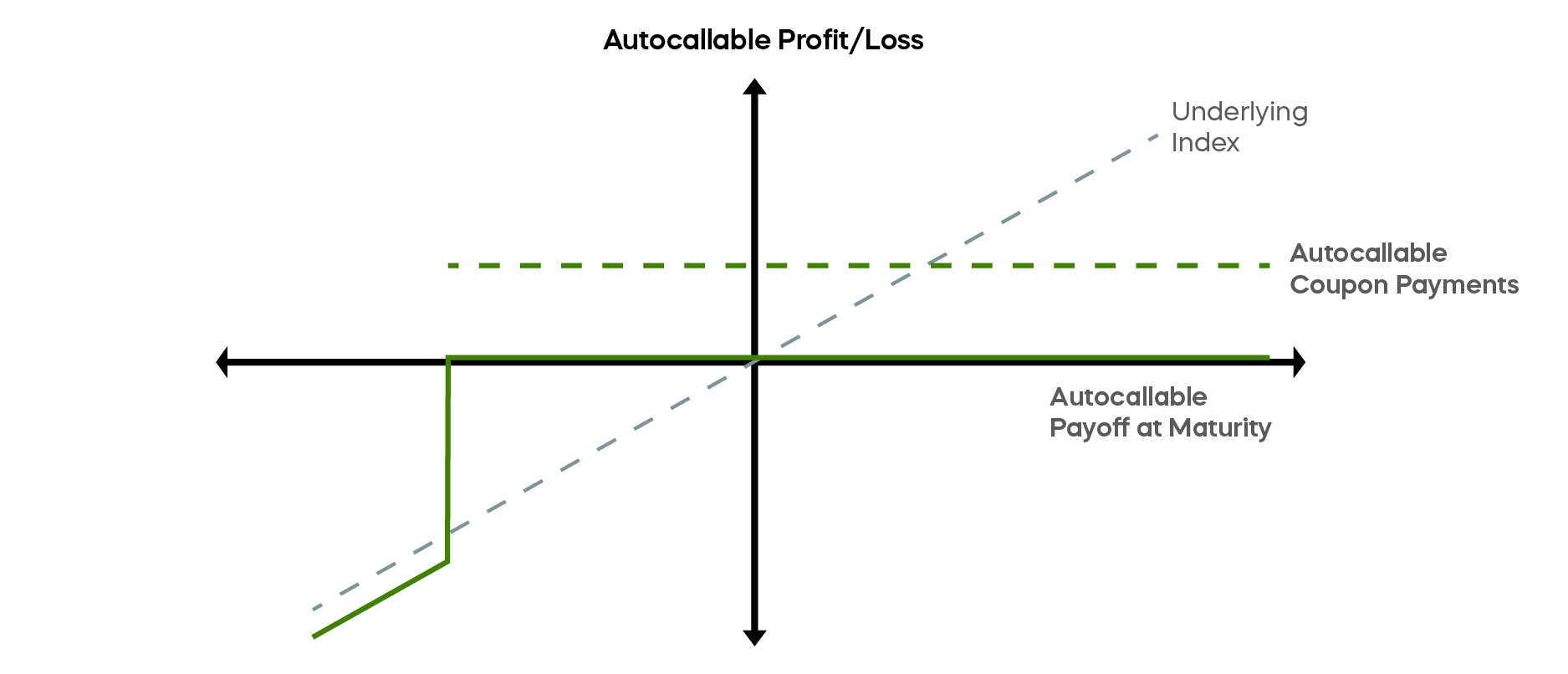
What does an autocallable note’s payment profile look like?
In the illustrated note structure below, investors would receive regular coupon payments and receive their principal back at maturity so long as the autocallable underlying index doesn’t fall below the barrier level. If the underlying index increases substantially in value after a typical non-call period, the note’s call would be triggered automatically and investors would receive their principal and final coupon payment. If the autocallable underlying index declined beyond the barrier at maturity, investors would lose a portion of their principal proportionate to the underlying index decline.
How does market activity affect autocallable returns?
While an autocallable’s final payout is event driven, as we discussed above, equity markets move every day and may impact the intraperiod value of an individual note.
The sensitivity of an individual autocallable’s price movement relative to changes in the market can depend on factors like how close it is to maturity, how close it is to a call price or a barrier, or whether the note was already below its barrier. As a result, autocallable notes can trade at a premium or discount to their par values throughout their holding period.
How market moves change the intraperiod value of autocallables
|
Underlying Rises |
Underlying Falls |
Underlying Is Flat |
Underlying Falls Significantly |
|
|---|---|---|---|---|
|
Short-Term Performance |
Note appreciates modestly until each coupon payment (unless it was already beneath its barrier, in which case it appreciates significantly).
|
Note falls but typically with less magnitude than underlying. |
There is minimal price movement in the note. |
Note typically falls in proportion to its underlying. |
|
Long-Term Performance |
Note returns to par value, and its total return depends solely on the income component. |
If the downside barrier is not breached, the note returns to par, and its total return depends solely on the income component. |
Note returns to par value, and its total return depends solely on the income component. |
If the downside barrier is breached, the note loses value proportionate to the decline in the underlying, and the principal returned is less than 100% of the initial investment.
|
What are the challenges of managing individual autocallable notes?
Investors in individual autocallable notes may receive attractive income with an outcome specifically selected to meet their needs. But investing in individual notes can be challenging and requires an investor to have a detailed understanding of note pricing, terms and structures.
Individual notes can also introduce significant risks, including concentration risk, issuer credit risk (which investors must monitor closely), and liquidity risk (where the secondary market for notes may be limited). They also carry reinvestment risk when a note is called early or matures.
To address concentration and other risks, autocallable investors generally need to assemble and manage a whole portfolio of multiple individual notes. In addition to the aforementioned individual note risks, managing a portfolio of autocallable notes introduces significant operational complexity. Each note adds its own terms, performance characteristics and risks to the portfolio.
Even financial advisors can find it challenging to build a highly customized structured-note strategy at an appropriate scale.
Introducing the ProShares Autocallable Income ETFs
ProShares Autocallable Income ETFs are designed to track indexes that replicate the performance of a laddered portfolio of autocallable strategies. Each is designed to target high income and potentially tax-efficient distributions, and their laddered approach may help to address concentration and timing risks. The ETFs also each provide a single-ticker solution with liquidity, removing the burden of managing individual notes.
ProShares offers three distinct ETFs for major U.S. indexes:
- S&P 500 Autocallable Income ETF (Nasdaq: ACSP)
Seeks investment results, before fees and expenses, that track the performance of the S&P 500 Futures 35% Volatility Compass Autocall Index. - Nasdaq-100 Autocallable Income ETF (Nasdaq: ACQQ)
Seeks investment results, before fees and expenses, that track the performance of the Nasdaq-100 35% Volatility Compass 6D Autocallable A Index. - Russell 2000 Autocallable Income ETF (Nasdaq: ACRT)
Seeks investment results, before fees and expenses, that track the performance of the Russell 2000 Laddered Autocall Index.
How do ProShares Autocallable Income ETFs work?
Each ETF tracks the performance of an autocallable index. The autocallable indexes provide exposure to a laddered portfolio of a minimum of 52 autocallable notes, each of which references the performance of an autocallable underlying index for its volatility targeting, as described below.
| Step-by-Step Construction | ||
|---|---|---|
|
1. |
Parent Equity Index |
The broad-based, market cap-weighted equity index to which the autocallable underlying index is linked. |
|
2. |
Autocallable Underlying Index |
A 35% volatility target index dynamically adjusting leverage on a daily basis to the S&P 500, Nasdaq-100 or Russell 2000 indexes. |
|
3. |
Synthetic Autocallable Notes |
Rules-based autocallable payoff representations. |
|
4. |
Autocallable Index |
A laddered portfolio of 52–156 autocallable payoffs maintained in a single index, with monthly distributions. |
The ETFs gain their exposure by investing in derivatives and do not invest directly in individual autocallable notes.
What is volatility targeting and how does it help manage risk?
Each autocallable note followed in the ProShares Autocallable Income ETFs references a volatility targeting index which is referred to as the autocallable underlying index. Volatility targeting systematically adjusts the volatility of the autocallable underlying index to a fixed level.
It does this by increasing exposure to a parent equity index like the S&P 500 when markets are calm and reducing it when markets are turbulent. Volatility targeting typically increases its exposure by deploying leverage and decreases its exposure by moving towards cash on a dynamic basis. ProShares autocallable ETFs are structured around underlying indexes that use volatility targeting strategies (e.g., leverage up to 500%).
Using volatility targeting within an autocallable strategy may provide:
- Higher and more stable income.
- Potentially reduced downside risk driven by dynamic exposure.
There is, of course, no guarantee of these results.
What are the volatility reference indexes that ProShares uses?
ProShares' ETFs reference the following autocallable underlying indexes for volatility targeting in their strategies:
|
ETF Name |
Autocallable Underlying Index |
|---|---|
|
S&P 500 Autocallable Income ETF (Nasdaq: ACSP) |
S&P 500 Futures 35% Volatility Compass TCA 6% Decrement Index |
|
Nasdaq-100 Autocallable Income ETF (Nasdaq: ACQQ) |
Nasdaq-100 Intraday 35% Volatility Compass 6% Decrement Index |
|
Russell 2000 Autocallable Income ETF (Nasdaq: ACRT) |
Russell 2000 Futures 35% Volatility Compass 6% Decrement Index |
The volatility target index for each of the autocallable underlying indexes targets a consistent 35% volatility level. The 6% decrement represents an annual fixed deduction built into the autocallable underlying index that approximates the implementation cost of the strategy and helps target a high and consistent level of income.
The individual notes followed are structured as follows:
ProShares autocallable income note construction
|
Feature |
Target Level |
|---|---|
|
Maturity |
3 Years |
|
Non-Call Period |
1 Year |
|
Autocall Level |
100% of Par Value |
|
Autocall Barrier Observation |
Quarterly, Beginning After 1 Year |
|
Risk Barrier |
35% of the Autocallable Underlying Index |
|
Risk Barrier Observation |
Final Maturity |
How are the autocallable ladders structured?
One of the primary benefits of investing in an autocallable strategy through an ETF is a laddered approach. Laddering is achieved by investing in a portfolio of multiple autocallable notes, each of which has staggered issuance dates and parameters that are linked to the same underlying index. As new autocallable notes are introduced into the portfolio, existing ones either mature or are called away. This approach enables investors to have diversified exposure rather than purchasing a single autocallable note. Diversification does not ensure a profit or guarantee against a loss.
Hypothetical example of a laddered autocallable strategy
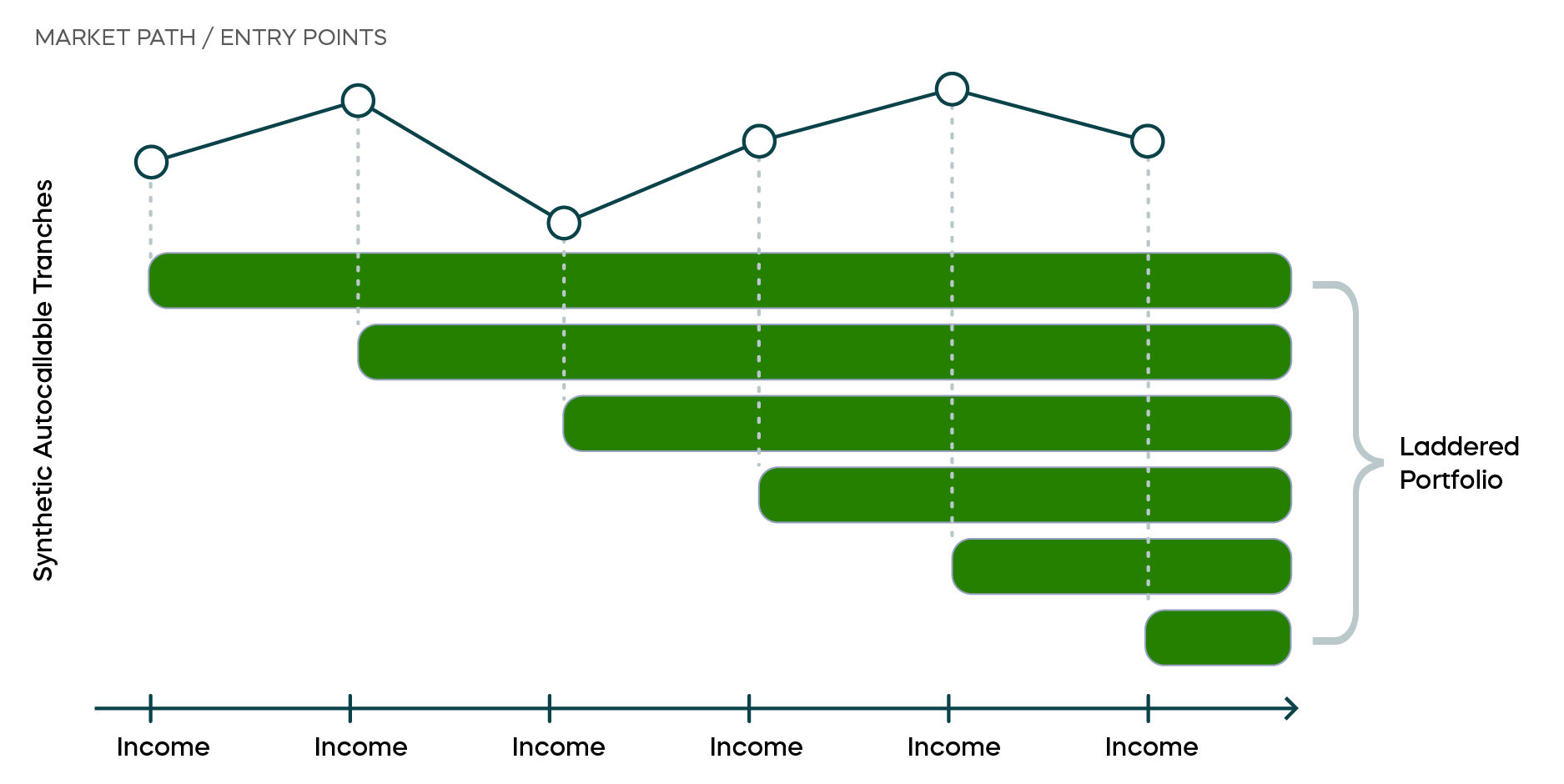
The ProShares ETFs follow a weekly ladder structure. Key potential benefits include:
- Single maturity risk
- Ad-hoc reinvestment risk
- Diversification
- A systematic approach to reinvestment
Return of capital provides a potential tax advantage
A significant portion of the monthly distributions investors receive from ProShares Autocallable Income ETFs may be characterized as Return of Capital (ROC). ROC is the portion of the fund’s distributions representing the return of your investment in the fund. ROC distributions are generally not taxable when received.
ROC distributions typically reduce an investor’s cost basis. When shares are sold, that reduced basis may result in the realization of a larger capital gain (or a smaller loss) for tax purposes. Then, as with most investments, if shares are held more than one year, such gains may be eligible for long-term capital gains treatment. While the funds’ distributions may offer potential tax benefits, they also may return a portion of an investor's own capital, thereby reducing the amount of the investor's principal that remains invested in the funds.
Why ProShares Autocallable Income ETFs
ProShares Autocallable Income ETFs may offer a potentially simpler solution for autocallable investors built to help address many of the risks and complications of investing in autocallable notes. The ETFs are designed to target high income and potentially tax-efficient distributions. They employ a laddered approach that may provide a more reliable return profile and income stream, while also potentially helping to address concentration and timing risks compared to single notes. Each fund also provides a liquid, single-ticker solution that removes the burden of managing individual notes.
Access the ProShares Autocallable ETF Dashboard
The ProShares Autocallable Dashboard, available on each ETF’s fund details page, offers investors real-time visibility into the performance potential of ProShares Autocallable Income ETFs. Review the notes and key terms underlying each of our autocallable ETFs, and access aggregate statistics for the full laddered portfolios, including yield, premium/discount to par, and time to maturity.
For illustrative purposes only.
Explore ProShares Autocallable Income ETFs
S&P 500 Autocallable Income ETF
Provides simplified access to a laddered portfolio strategy of S&P 500 based autocallable notes designed to target high income and potentially tax-efficient distributions.
Nasdaq-100 Autocallable Income ETF
Provides simplified access to a laddered portfolio strategy of Nasdaq-100 based autocallable notes designed to target high income and potentially tax-efficient distributions.
Russell 2000 Autocallable Income ETF
Provides simplified access to a laddered portfolio strategy of Russell 2000 based autocallable notes designed to target high income and potentially tax-efficient distributions.
Autocallable Income
This links to a pdf file
This link opens a new window
Autocallable Income
This links to a pdf fileThis link opens a new window