


An Innovative Strategy Designed to Harvest Income and Capture Upside
- The small-cap rally has continued, thanks primarily to a resilient economic backdrop and accelerating earnings growth.
- Today, small-caps can offer a timely opportunity for investors seeking to generate income and capture potential long-term growth.
- The ProShares Russell 2000 High Income ETF (ITWO) is an innovative covered call strategy that offers the potential to both access the long-term returns of small-caps and generate high levels of income.
Small-Caps Have Outpaced Large-Cap Stocks
The historical underperformance of small-caps relative to the top-heavy, large-cap S&P 500 over the last decade has been well documented. Anemic earnings growth and the outsized role of private markets in small-firm financing are largely to blame. According to Morningstar, public companies are increasingly being taken private, and many fast-growing small companies are remaining private for longer.[1] As a result, many investors have been either underweighting or outright avoiding small-cap stocks in their portfolios.
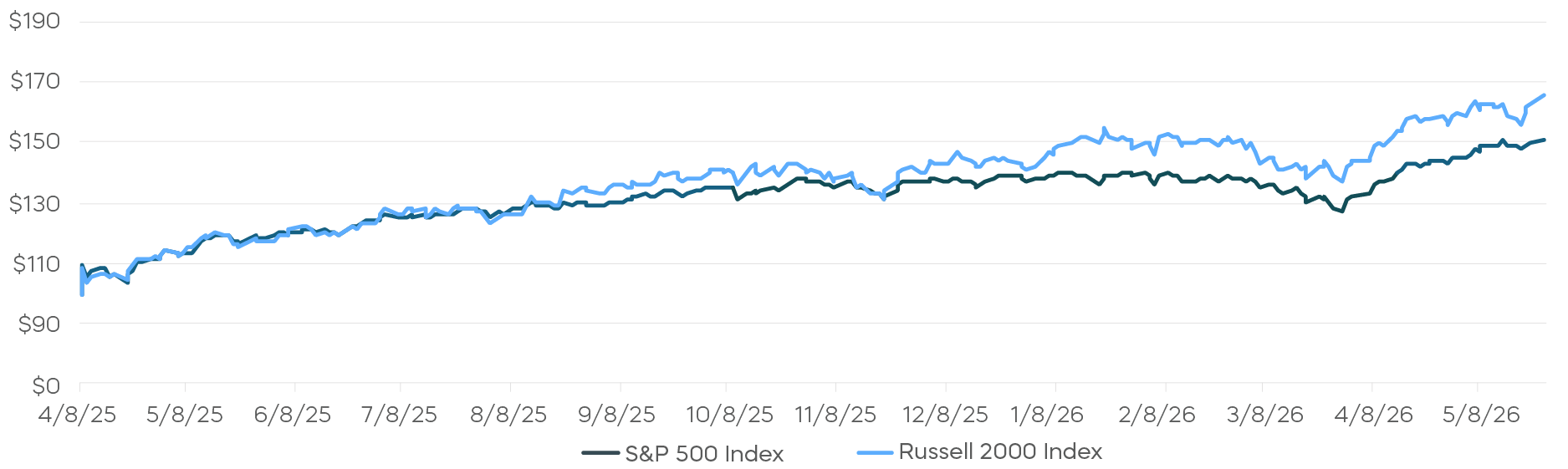
However, investors who have avoided small caps may have missed a meaningful opportunity. The Russell 2000 Index has outperformed in 2026, though the current rally began in early 2025. According to Bloomberg, since its low on April 8, 2025 through May 27, 2026, the Russell 2000 Index has rallied 55.8%. That is a 15.3% advantage over the S&P 500.
Small Caps Have Outperformed Since April 2025
We see three reasons why the current small-cap momentum could continue:
-
Resilient Economic Growth
Small-cap stocks have tended to perform better during the early stages of economic expansions. Knowing where we are in an economic cycle is tricky, but recent data suggests resilient economic growth despite current geopolitical uncertainty. According to the U.S. Bureau of Economic Analysis, Q2 and Q3 2025 real GDP increased at annualized rates of approximately 4%, reversing three consecutive quarters of declining growth. While growth has slowed since, the International Monetary Fund’s 2026 expectations for growth are slightly higher than last year’s.
-
Recent Legislation
Government policy may give a further boost to small-cap stocks. Recent federal legislation, including the CHIPS Act, the Infrastructure Investment and Jobs Act and other domestic investment initiatives, could support higher U.S. capital expenditure. And since smaller companies typically have more domestic exposure, they may be well positioned to benefit.
-
Improving Fundamentals
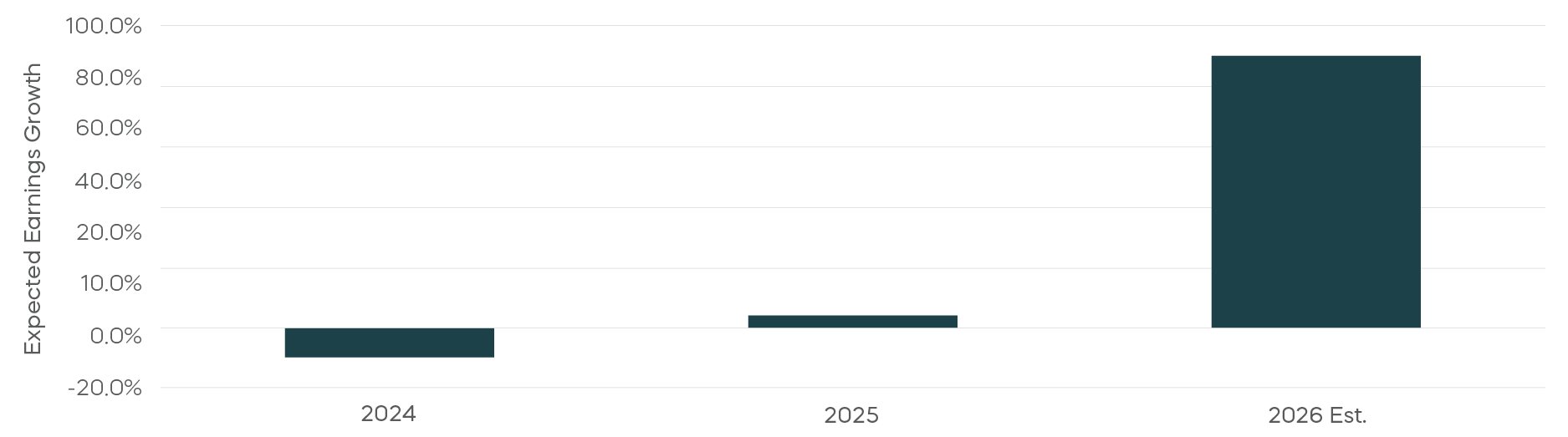
The small-cap market may be entering a period of elevated earnings growth, per FactSet. After an earnings recession in 2024 and essentially flat growth in 2025, the Russell 2000 Index is expected to deliver stronger earnings growth in 2026.
Small Caps May Be at an Earnings Inflection Point
Despite its potentially favorable growth trajectory, the Russell 2000 has also been trading at a favorable valuation relative to the S&P 500 (Source: FactSet, based on trailing 12-month P/E ratios as of 5/26/26). Against that backdrop, investors may want to consider an innovative approach to small-cap investing.
How to Potentially Generate High Income and Long-Term Returns from Small Caps
Covered call strategies have become popular over the past few years based on their potential to capture both equity market upside and high levels of income. While many such funds often focus on the S&P 500, small-cap stocks may be well suited to a covered call strategy because of their frequently higher implied volatility.
Greater volatility means that a small-cap strategy can often demand higher options premiums, which covered call strategies can harvest and translate into potentially higher levels of income than comparable large-cap strategies.
But there is a catch: Traditional covered call strategies that use monthly expiring options—a proxy for which is the Russell 2000 BuyWrite Index—have generally sacrificed significant total return in exchange for high levels of income. And for small caps, that trade-off can be particularly costly.
Why a Daily Small-Cap Covered Call Strategy May Outperform
A recent innovation—daily options—makes it possible to offer a solution designed to help investors seek higher levels of income while also potentially capturing long-term returns that monthly small-cap strategies can miss.
ProShares Russell 2000 High Income ETF (ITWO), which tracks the Cboe Russell 2000 Daily Covered Call Index, employs this type of strategy,[2] enabling investors to seek high levels of income while capturing more of the Russell 2000 Index’s growth over time.
According to Bloomberg, from the strategy’s inception in September of 2024 through April 30, 2026, ITWO’s strategy generated a higher total return than the Russell 2000 Index,[3] and its most recent 12-month distribution rate was 8.11%, as of April 30, 2026.
A Small-Cap, Covered Call Strategy Powered by Daily Options Has Outperformed
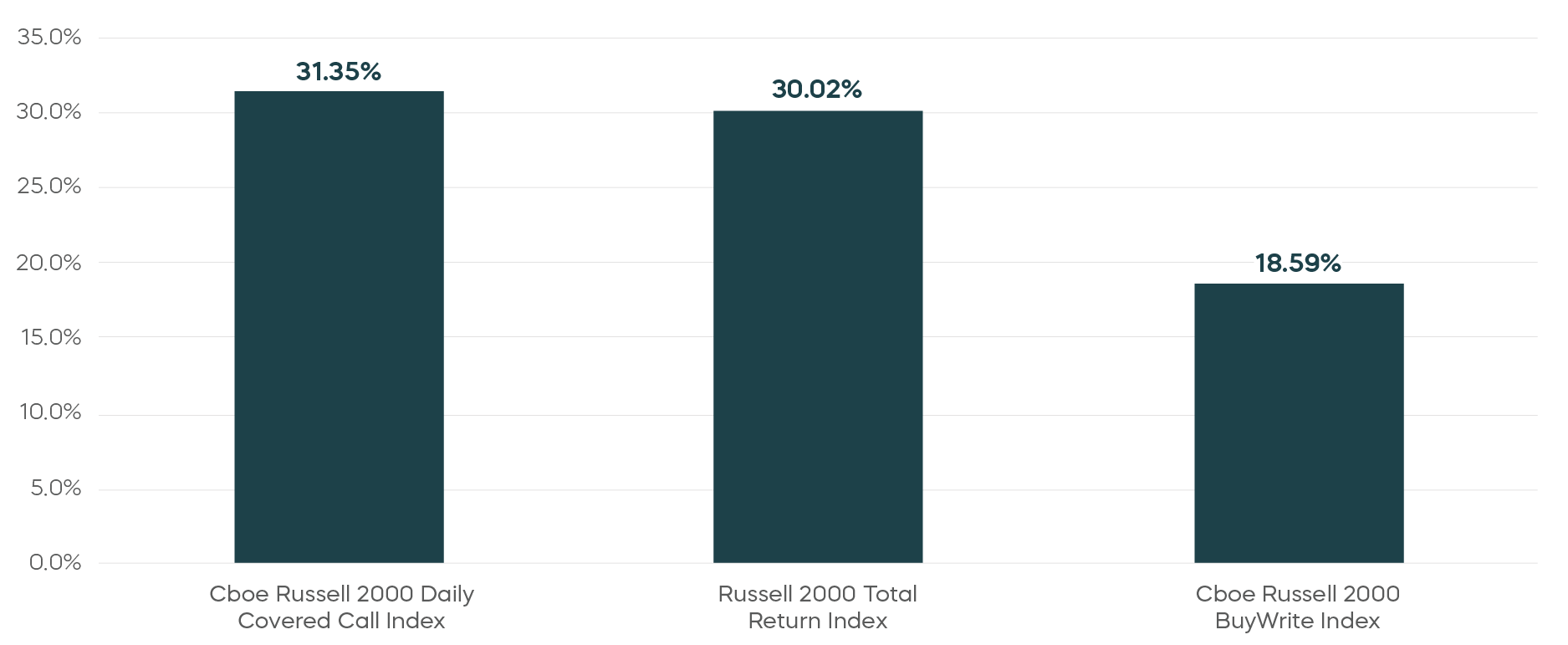
Source: Bloomberg, based on total returns from 8/27/24 to 4/30/26. Index returns are for illustrative purposes only and do not represent actual fund performance. Index returns do not reflect any management fees, transaction costs or expenses. Indexes are unmanaged and one cannot invest directly in an index. Past performance does not guarantee future results.
ITWO’s performance as of 3/31/26: One-year is 25.21% (NAV) | 25.29% (Market Price); Since 9/4/24 inception is 12.00% (NAV) | 12.10% (Market Price).
The 12-Month Distribution Rate represents the sum of ITWO's distributions for the last 12 months, expressed as a percentage of the NAV at the end of the previous month. Distributions may include return of capital which may be taxable or non-taxable. As of 1/29/2026, fund distributions are subject to a minimum yield. See end disclosures for important information regarding this change. The characterization as return of capital does not impact whether the distribution is taxable. Distributions will reduce the NAV by the amount of the distribution. Future distributions may differ significantly from the latest distribution and are not guaranteed. Actual sources of the distributions may vary at the end of the year and will be provided in a Form 1099-DIV.
The performance quoted represents past performance and does not guarantee future results. Investment return and principal value of an investment will fluctuate so that an investor's shares, when sold or redeemed, may be worth more or less than the original cost. Shares are bought and sold at market price (not NAV) and are not individually redeemed from the fund. Market price returns are based upon the midpoint of the bid/ask spread at 4:00 p.m. ET (when NAV is normally determined for most funds). Your brokerage commissions will reduce returns. Current performance may be lower or higher than the performance quoted. For standardized returns and performance data current to the most recent month end, see the Performance page.
The Takeaway
Small-cap stocks may be well positioned to continue their rally thanks to a combination of resilient economic growth and improving earnings. In addition to capturing small-caps’ potential upside, an innovative, index-based strategy like the ProShares Russell 2000 High Income ETF (ITWO) potentially offers investors the opportunity to both earn high levels of income and capture more of the small-cap market’s long-term total return.
Learn More
ITWO
Russell 2000 High Income ETF
ProShares Russell 2000 High Income ETF seeks investment results, before fees and expenses, that track the performance of the Cboe Russell 2000 Daily Covered Call Index.