

Key Takeaway
When deciding how to hedge their portfolios, many investors turn to traditional hedging tools such as futures, options and short selling. But these approaches often present challenges to everyday investors that a hedging strategy using inverse ETFs can help to overcome.
What are the drawbacks of traditional hedging strategies?
Futures, options and short selling can be effective tools for hedging, but they may also have significant potential drawbacks for investors, such as:
- They can be expensive to implement.
- They may expose investors to unlimited losses due to margin calls.
- They may be difficult to access for investors without very large portfolios due to high minimum investment requirements.
What are inverse ETFs, and how do they offer a convenient way to hedge?
Inverse ETFs, which are readily accessible in brokerage accounts, can help overcome many of the challenges of futures, options and short selling. An inverse ETF is an exchange-traded fund that seeks to provide a daily return that is the inverse (or a multiple of the inverse) of the daily performance of an underlying benchmark, typically an index.
If the underlying index goes down, the inverse ETF is designed to go up, and vice versa. These are often referred to as “-1x inverse ETFs” since they are designed to move in the opposite direction of the underlying index each day.
Most inverse ETFs track popular indexes such as the S&P 500, the Nasdaq-100, or various industry sector indexes. Of course, most investors’ portfolios won’t exactly match one of these indexes, so the inverse ETF you hedge with likely won’t exactly offset losses or gains in your portfolio. But when used in the right environments, an inverse ETF tracking an index that best matches your investments can significantly cushion your portfolio from market declines or corrections.
How Inverse ETFs Work: Inverse ETF Daily Expected Investment Returns Relative to Index
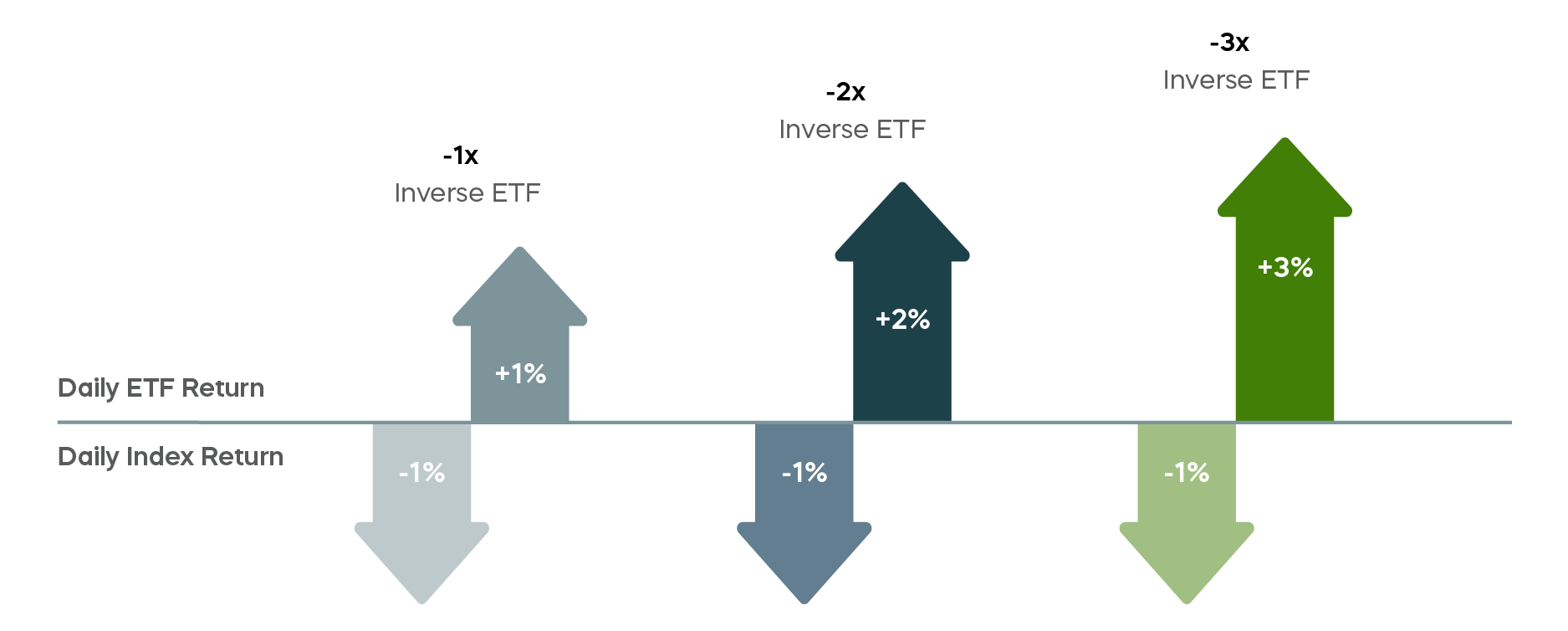
For investors seeking more exposure per dollar invested, -2x and -3x inverse ETFs are designed to provide a return that is a multiple of the daily inverse of a given index. For example, a -2x inverse ETF is designed to go up twice the amount that the market goes down in a given day (and vice versa). These ETFs are valued by investors seeking inverse exposure with less invested capital.
However, -2x and -3x inverse ETFs may also be riskier and more volatile than -1x ETFs with similar investment strategies. Investors should carefully weigh this risk versus the benefit of achieving magnified exposure when choosing among -1x, -2x and -3x options.
What are the potential advantages of hedging with inverse ETFs?
Inverse ETFs may enable you to achieve similar outcomes to strategies using futures, options, and short selling. But when compared to these other tools, inverse ETFs have several potential advantages that can make them an attractive choice for many investors.
Convenience
- Inverse ETFs are typically available in standard brokerage accounts and can be bought and sold using a ticker like other ETFs and stocks.
Accessibility
- The price of one share of an inverse ETF is typically less than $100, making it accessible for investors with smaller account sizes.
Potentially lower cost
- Inverse funds may be more cost-effective than other hedging methods including using options, buying on margin, and short selling. Also, most brokers no longer charge commissions to trade ETFs.
Loss limitation
- An investor in inverse ETFs cannot lose more than they have invested in the fund and will not be subject to margin calls (unless you purchase the ETF on margin).
What you should know about performance over time and rebalancing inverse ETFs
As with other investment products, inverse ETFs have important considerations that an investor should be aware of when deciding to use them in their portfolio, including:
Performance over time
- When an investor holds an inverse ETF for any period other than one day, their return is likely to be higher or lower than the fund's multiple (e.g. -2x) over the period.
Rebalancing and monitoring
- As markets move, the value of securities in an index rises and falls. Since an inverse ETF should move in the opposite direction of its underlying index each day, its value—along with the value of most other investments an investor may hold—will shift over time. Investors should consider periodically monitoring and adjusting their holdings in inverse funds to ensure they remain consistent with their risk tolerance and financial objectives.
Important information about using -2x and -3x inverse ETFs
While a hedge using an inverse ETF is designed to lower overall investment risk, there are important considerations when using -2x or -3x inverse ETFs. These ETFs can allow an investor to create a hedge with a lower amount of capital, because they are designed to achieve double or triple the exposure of each dollar invested on a daily basis. However, this higher exposure also increases potential volatility and creates a higher risk of loss.
As with other investments you should read any ETF's prospectus before investing.