Harvesting tax losses while positioning for rising rates

November 16, 2026
STRATEGY Rising Interest Rates
Learn More
Rising Interest Rates
Learn More

Rising interest rates and inflation have made 2026 among the worst on record for bond investors. However, there may be a silver lining in the sell-off. A review of bond fund investments may present the opportunity to harvest losses, attempt to offset capital gains distributions from actively managed funds, and prepare for potentially rising rates.

  • Bond Fund Losses Are Widespread: When interest rates rise, bonds lose money. Rising rates have left many bond funds with negative returns so far this year.
  • Harvesting Losses May Help Reduce Tax Burden: When held in taxable accounts, bond funds that have lost value may be sold to offset gains elsewhere and help to reduce taxes.
  • Consider Potential Capital Gains Distributions: For investors in actively managed mutual funds, the prospect of capital gains distributions could increase the importance of exiting positions with losses. According to Morningstar, 53% of actively managed mutual funds distributed capital gains in 2025.
  • Prepare for Rising Rates: Making year-end shifts in portfolio allocations is an opportunity to revisit investors’ fixed income strategies. Interest Rate Hedged Bond ETFs could be a replacement to help prepare for potentially rising rates.


Year-to-Date Returns 1/1/2026–10/29/2026
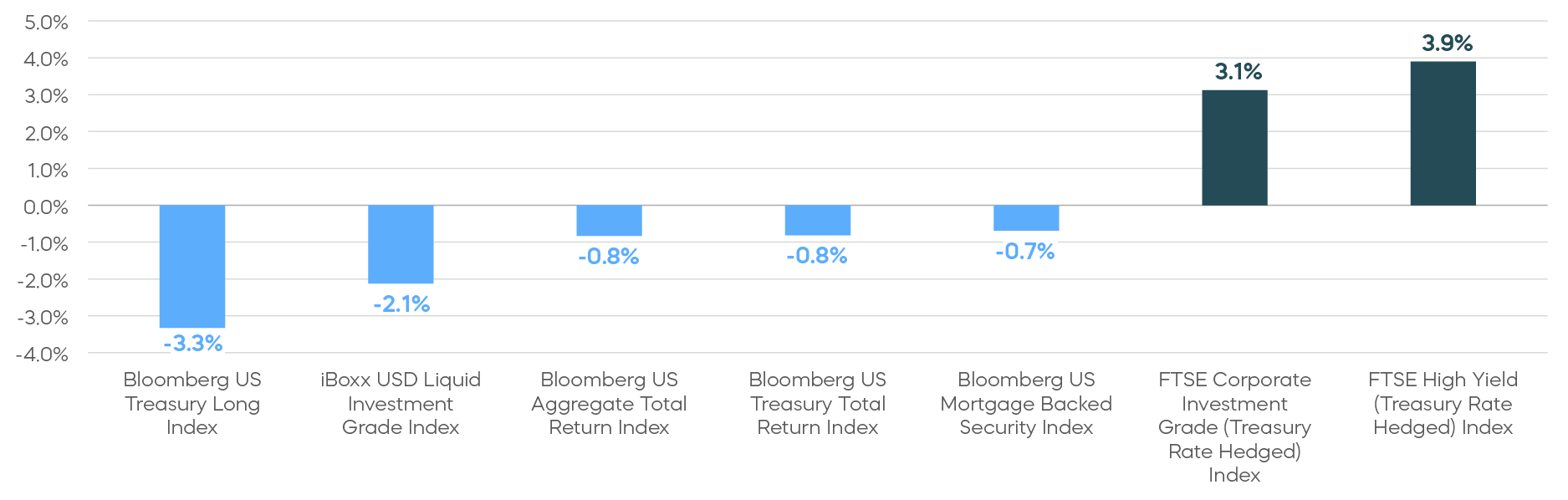
261109-BR-Tax-Loss-Harvesting_Covered Call_Covered Call.png

Source: Bloomberg, 1/1/2026-10/29/2026.

Index returns are for illustrative purposes only and do not represent actual Fund performance. Index returns do not reflect any management fees, transaction costs or expenses. Indexes are unmanaged and one cannot invest directly in an index. Past performance does not guarantee future results.


If your bond funds have lost money this year, you may be looking to harvest losses to offset potential capital gains in other areas. If so, consider replacing some of your holdings with Interest Rate Hedged ETFs, like ProShares Investment Grade—Interest Rate Hedged (IGHG) and ProShares High Yield—Interest Rate Hedged (HYHG). IGHG and HYHG are diversified portfolios of long-term investment grade bonds with a built-in hedge designed to alleviate the impact of rising rates.

Learn More

IGHG

Investment Grade - Interest Rate Hedged

Seeks investment results, before fees and expenses, that track the performance of the FTSE Corporate Investment Grade (Treasury Rate-Hedged) Index.

HYHG

High Yield - Interest Rate Hedged

Seeks investment results, before fees and expenses, that track the performance of the FTSE High Yield (Treasury Rate-Hedged) Index.

STRATEGY Rising Interest Rates
Learn More
Rising Interest Rates
Learn More
Get the latest perspectives and updates.

There is no guarantee that the strategies discussed will be effective. The information and examples provided are not intended to be a complete analysis of every material fact respecting tax strategy and are presented for educational and illustrative purposes only. Tax consequences will vary by individual taxpayer, and individuals must carefully evaluate their tax position before engaging in any tax strategy. All regulated investment companies, including ProShares, are obliged to distribute portfolio gains to shareholders at year’s end. Trading shares of the funds will also generate tax consequences and transaction expenses. This material is not intended to be tax advice. 

ProShares does not offer tax advice and you should consult your tax advisor before selling or buying any investments. 

Investing involves risk, including the possible loss of principal. ProShares ETFs are generally non-diversified and each entails certain risks, which may include risk associated with the use of derivatives (swap agreements, futures contracts and similar instruments), investments in smaller companies, imperfect benchmark correlation, leverage and market price variance, all of which can increase volatility and decrease performance. Please see summary and full prospectuses for a more complete description of risks. There is no guarantee any ProShares ETF will achieve its investment objective. 

HYHG and IGHG do not attempt to mitigate factors other than rising Treasury interest rates that impact the price and yield of corporate bonds, such as changes to the market’s perceived underlying credit risk of the corporate entity. HYHG and IGHG seek to hedge high yield bonds and investment grade bonds, respectively, against the negative impact of rising rates by taking short positions in Treasury futures. These positions lose value as Treasury prices increase. Investors may be better off in a long-only high yield or investment grade investment than investing in HYHG and IGHG when interest rates remain unchanged or fall, as hedging may limit potential gains or increase losses. No hedge is perfect. Because the duration hedge is reset on a monthly basis, interest rate risk can develop intra-month, and there is no guarantee the short positions will completely eliminate interest rate risk. Furthermore, while HYHG and IGHG seek to achieve an effective duration of zero, the hedges cannot fully account for changes in the shape of the Treasury interest rate (yield) curve. HYHG and IGHG may be more volatile than a long only investment in high yield or investment grade bonds. Performance of HYHG and IGHG could be particularly poor if high yield or investment grade credit deteriorates at the same time that Treasury interest rates fall. There is no guarantee the fund will have positive returns. 

Bonds will decrease in value as interest rates rise. Short positions in a security lose value as that security’s price increases.

The fund concentrates its investments in certain sectors. Narrowly focused investments typically exhibit higher volatility. 

Carefully consider the investment objectives, risks, charges and expenses of ProShares before investing. This and other information can be found in their summary and full prospectuses. Obtain them from your financial professional or visit ProShares.com. Read them carefully before investing. 

“FTSE®,” "FTSE High Yield (Treasury Rate Hedged)" and “FTSE Corporate Investment Grade (Treasury Rate Hedged)” have been licensed for use by ProShares. FTSE is a trademark of the London Stock Exchange Plc and The Financial Times Limited and is used by the FTSE International Limited ("FTSE") under license. ProShares have not been passed on by FTSE or its affiliates as to their legality or suitability. ProShares based on the FTSE Corporate Investment Grade (Treasury Rate Hedged) Index and FTSE High Yield (Treasury Rate-Hedged) Index are not sponsored, endorsed, sold or promoted by FTSE or its affiliates, and they make no representation regarding the advisability of investing in ProShares. THESE ENTITIES AND THEIR AFFILIATES MAKE NO WARRANTIES AND BEAR NO LIABILITY WITH RESPECT TO PROSHARES. 

ProShares are distributed by SEI Investments Distribution Co., which is not affiliated with the funds’ advisor or sponsor.

Your use of this site signifies that you accept our Terms and Conditions of Use.