

 Crypto

Key Takeaways
- Bitcoin prices rebounded in mid-August after a year of mostly steady declines.
- The rally accelerated after the U.S. Treasury announced large buybacks of long-dated securities in an effort to support bond prices.
- Crypto investors may take that as a sign the “debasement trade” is back on.
- Other developments, like the expansion of stablecoins and broader gains across cryptocurrencies, also seem to have renewed interest in the sector.
Is bitcoin’s bad year improving?
Following steady declines so far in 2026, bitcoin has found some life. Since the middle of August, prices have risen more than 20% and temporarily breached the $80,000 mark.[1] But perhaps more interesting than the overall move is what appears to be driving it.
What drove bitcoin’s August rebound?
Until that short, sharp mid-August spike, bitcoin trading had been characterized by falling momentum and relative underperformance.
Then, on August 19, Treasury Secretary Scott Bessent announced increased bond buybacks to support longer-dated bonds. Crypto traders immediate took notice, while the intended effect—liquidity support for bonds—may not have worked as intended yet (yields on long-dated bonds rose). What crypto’s boost may reflect is concern over how such interventions might play out at a time when deficits remain at all-time highs. While hardly equivalent to “printing money,” efforts to provide support to Treasury markets resurrect an old question: At what point does managing an increasingly large national debt call creditworthiness and currency value into question?
Investments in crypto ETFs have returned as well. U.S. spot bitcoin ETFs generated approximately $3 billion of net inflows through late August, including more than $600 million on August 20 alone.[2]
Is the “debasement trade” back?
So far, long-dated Treasury yields have remained elevated, while concerns surrounding inflation and the U.S. fiscal position have persisted. Both bitcoin and gold responded by moving higher, both seemingly drawing investor interest in the so-called “debasement trade,” when demand for scarce or alternative assets increases in the face of concern over fiscal issues and weakening currencies.
Here, the concurrent rise in both bitcoin and gold is notable. Bitcoin has often been described as “digital gold,” but historical behavior has been much more sensitive to liquidity than gold. Recent price action arguably reflects concern about both the price and supply of money. Shorter-dated Treasury yields have declined, as expectations for additional Federal Reserve tightening have faded. Meanwhile, longer-dated yields have remained elevated amid fiscal concerns.
Bitcoin Has Risen Following Treasury’s Recent Bond Market Interventions
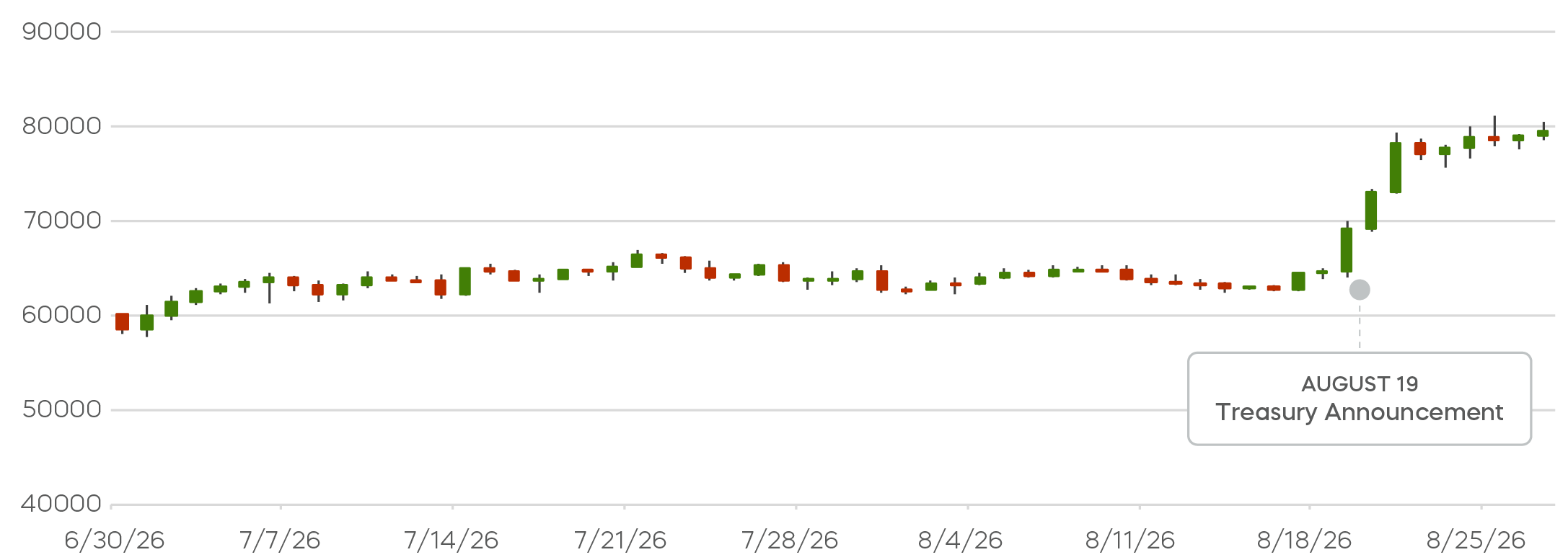
Source: CoinMarketCap, data from 06/30/26-08/27/26. Past performance does not guarantee future results.
Crypto’s narrative broadens beyond bitcoin
While bitcoin has impressed over the past few weeks, it has trailed a number of its lesser-known crypto peers including XRP and Solana. Over the past month, eight constituents of the CoinDesk 20 Index, an index designed to measure the performance of the 20 largest and most liquid eligible cryptocurrencies, outperformed bitcoin, including four that also outperformed ether.[3]
Meanwhile, on-chain developments suggest that crypto is becoming about more than prices. Stablecoin supply has continued to expand. The stablecoin USD Coin (USDC) ended the second quarter with $73.3 billion in circulation, up 19% year over year.[4] Perhaps more notable was the $14.8 trillion in USDC on-chain transaction volume during the quarter, representing a 151% increase from 2025.[5]
Crypto adoption still lies outside the mainstream, but such figures suggest growing use of crypto infrastructure for settlement and payments.
Is the crypto bear market over?
If the recent acceleration in bitcoin (and across the cryptocurrency market) continues, we may have seen the end of 2026’s bear market for bitcoin. But a bullish signal may not immediately translate into a bullish outcome. Market pressures remain. Inflation persists above the Federal Reserve’s target, geopolitical uncertainty continues, and bitcoin remains well below its prior all-time highs.
Still, ETF inflows, increased institutional interest, and renewed concerns surrounding the potential debasement of fiat currency (government-issued currency) may offer crypto bulls sufficient reason for optimism.
[1] Source: Coinmarketcap, data from 08/01/26 to 09/03/26.
[2] Source: Bloomberg, data as of 8/20/26.
[3] Source: CoinMarketCap, price returns from 07/26/26 through 08/26/26.
[4] Source: CoinMarketCap, data as of 8/27/26.
[5] Source: CoinMarketCap, data as of 8/27/26.
Learn More
KRYP
CoinDesk 20 Crypto ETF
Seeks investment results, before fees and expenses, that track the performance of the CoinDesk 20 Index.
BITO
Bitcoin ETF
Seeks investment results, before fees and expenses, that correspond to the performance of bitcoin.
EETH
Ether ETF
Seeks investment results, before fees and expenses, that correspond to the performance of ether.
SLON
Ultra Solana ETF
Seeks daily investment results, before fees and expenses, that correspond to two times (2x) the daily performance of the Bloomberg Solana Index.
UXRP
Ultra XRP ETF
Seeks daily investment results, before fees and expenses, that correspond to two times (2x) the daily performance of the Bloomberg XRP Index.
Crypto
Crypto