


Key Takeaways
- Small-cap stocks have outperformed their larger-cap peers since mid-2025 as U.S. market leadership broadened beyond mega-cap technology companies.
- The current small-cap rally has been driven largely by lower-quality stocks. But history suggests that higher quality small-cap stocks have outperformed over time.
- The ProShares S&P SmallCap 600 Dividend Aristocrats ETF (SMDV) is the only ETF focused exclusively on the S&P SmallCap 600 Dividend Aristocrats—companies that have grown their dividends for at least 10 consecutive years—offering investors exposure to small caps with an emphasis on quality, financial discipline, profitability, and growth.
Why a quality-focused small-cap approach may be timely
For several years, U.S. equity leadership has been dominated mostly by large-caps and by mega-cap tech companies. But market conditions may be shifting to favor small-cap stocks once again.
- Market leadership has broadened, and small-cap stocks have been outperforming their larger capitalization peers since mid-2025.[1]
- Investing in small caps offers investors the opportunity to diversify portfolios that may have become increasingly concentrated in AI-centric mega-cap stocks.[2]
- Smaller companies generally carry greater financial and operational risks, making a selective, quality-focused investment approach potentially appealing to many investors.
That combination—small-cap leadership paired with an emphasis on quality—is what makes the ProShares S&P SmallCap 600 Dividend Aristocrats ETF (SMDV) a potentially compelling way to access this sector now.
What's driving the current small-cap rally?
Powered by fundamentals like strong earnings, the S&P SmallCap 600 Index has rallied 33.9% since May 31, 2025, outperforming both mid-cap (S&P MidCap 400 Index) and large-cap stocks (S&P 500 Index), as shown below.
Small Cap Stocks Have Been Outperforming
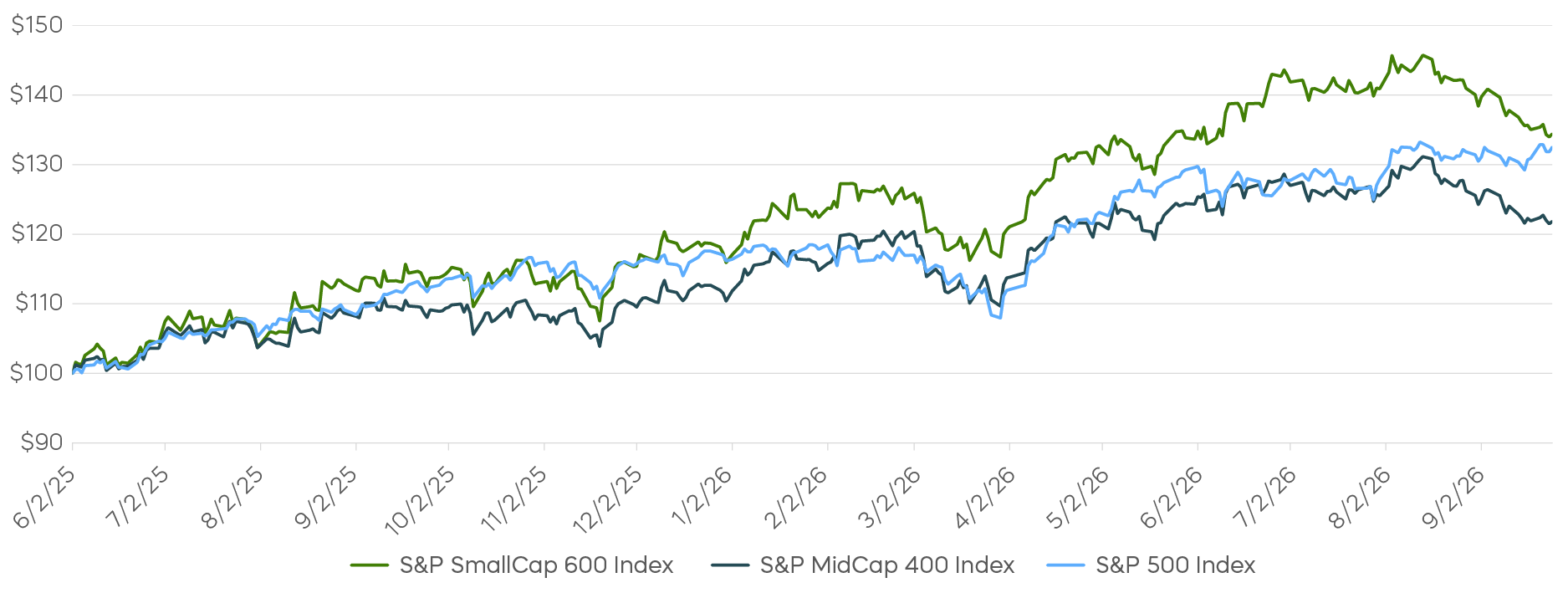 Source: Bloomberg. Data from 5/31/25 to 9/25/26. Index returns are for illustrative purposes only and do not reflect any management fees, transaction costs or expenses. Indexes are unmanaged, and one cannot invest directly in an index. Past performance does not guarantee future results.
Following an earnings recession in 2024 and essentially flat growth during 2025, small-cap fundamentals may have now reached an inflection point this year that could give the current rally some staying power. The S&P SmallCap 600 Index is projected to deliver mid-teens earnings growth in 2026 and 2027 while potentially trading at discounted multiples relative to large-cap stocks, according to FactSet as of September 29, 2026.
Within the small-cap universe, one interesting dynamic of the current rally has been the leadership of potentially riskier, lower-quality companies. According to FactSet, approximately 43% of stocks in the Russell 2000 Index produced negative net income per share as of their latest fiscal year. That index outperformed the S&P SmallCap 600 Index, which includes a quality-focused filter requiring its constituents to have positive cumulative net income, by approximately 6% from May 31, 2025 through September 25, 2026 (Source: Bloomberg). While lower-quality stocks may have benefitted so far from market momentum and a resilient economy, other factors (including rising interest rates) could make their future leadership less certain.
Quality small-caps have outperformed over time
Over the long term, a higher-quality approach to small caps has typically outperformed. Since its inception in October 1994, the more quality-focused S&P SmallCap 600 Index has outperformed the Russell 2000 Index, 10.65% versus 9.25% (1.4% annualized), generally with less volatility, according to Bloomberg (see below).
Higher Quality Small Caps Have Outperformed Lower Quality Over Time
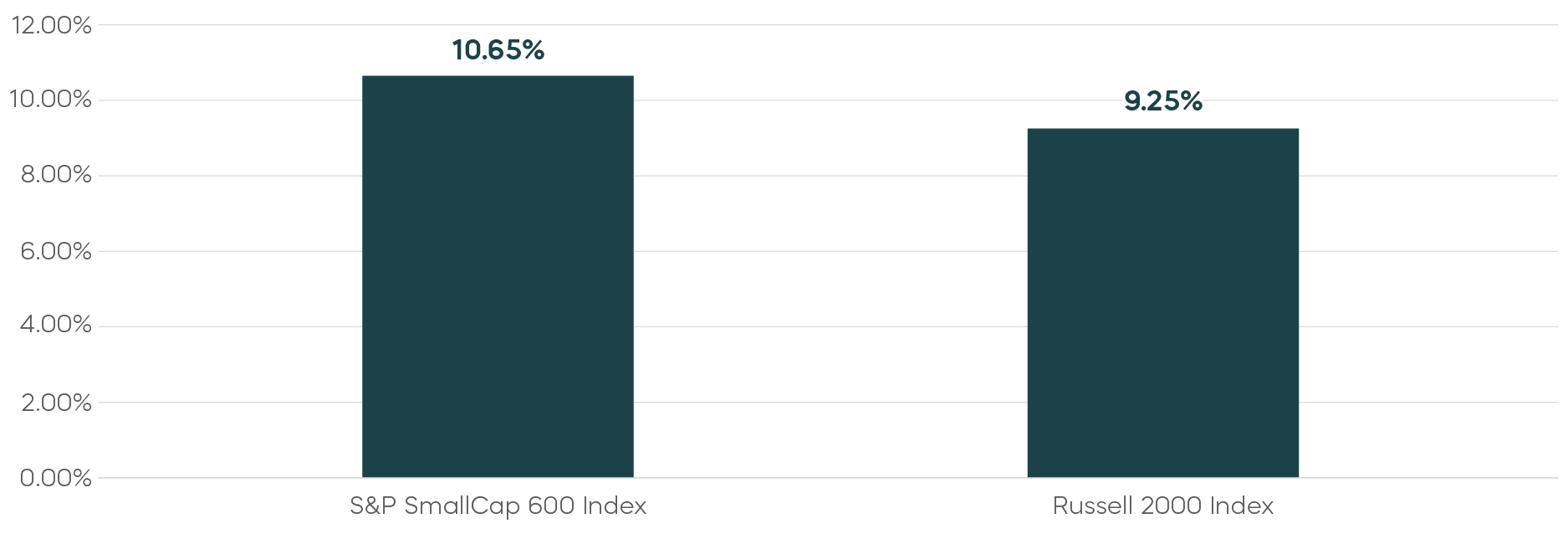
Source: Bloomberg. Data from 10/28/1994 to 9/28/2026. Index returns are for illustrative purposes only and do not reflect any management fees, transaction costs or expenses. Indexes are unmanaged, and one cannot invest directly in an index. Past performance does not guarantee future results.
The S&P SmallCap 600 Dividend Aristocrats Index focuses on quality
While the S&P SmallCap 600 Index has a profitability requirement that tilts the index toward quality, focusing on companies that continuously grow their dividends can take that one step further.
Dividend growth investing is a well-established strategy for identifying high-quality companies that display financial strength and capital discipline over time. The S&P 500 Dividend Aristocrats Index was launched in 2005 and tracks companies in the S&P 500 that have increased their dividends for at least 25 consecutive years. The strategy has historically weathered market turbulence and generally helped investors create and protect wealth with a growing income stream over time.
The new S&P SmallCap 600 Dividend Aristocrats Index translates the S&P 500 Dividend Aristocrats approach to small-cap stocks.
To qualify for the S&P SmallCap 600 Dividend Aristocrats, companies must be members of the S&P SmallCap 600 Index and have increased their dividends for at least 10 consecutive years. The index is equally weighted and applies a liquidity requirement as part of its stringent requirements.
Ten consecutive years of dividend increases represents a demanding standard for a small company. Over a decade, a business is likely to encounter numerous challenges to its bottom line. A company capable of consistently raising its dividend through a range of economic and business cycles typically possesses characteristics that investors associate with quality, such as durable cash flows, prudent balance-sheet management, disciplined capital allocation, and management confidence in the sustainability of the business.
According to FactSet (see below), the members of the S&P SmallCap 600 Dividend Aristocrats Index produce more than double the profit margins and almost seven times the return on equity of their Russell 2000 Index peers. Even compared against the S&P SmallCap 600 Index, the Dividend Aristocrats have produced significantly higher measures of quality.
Small Cap Dividend Growth Stocks Reflect High-Quality Attributes
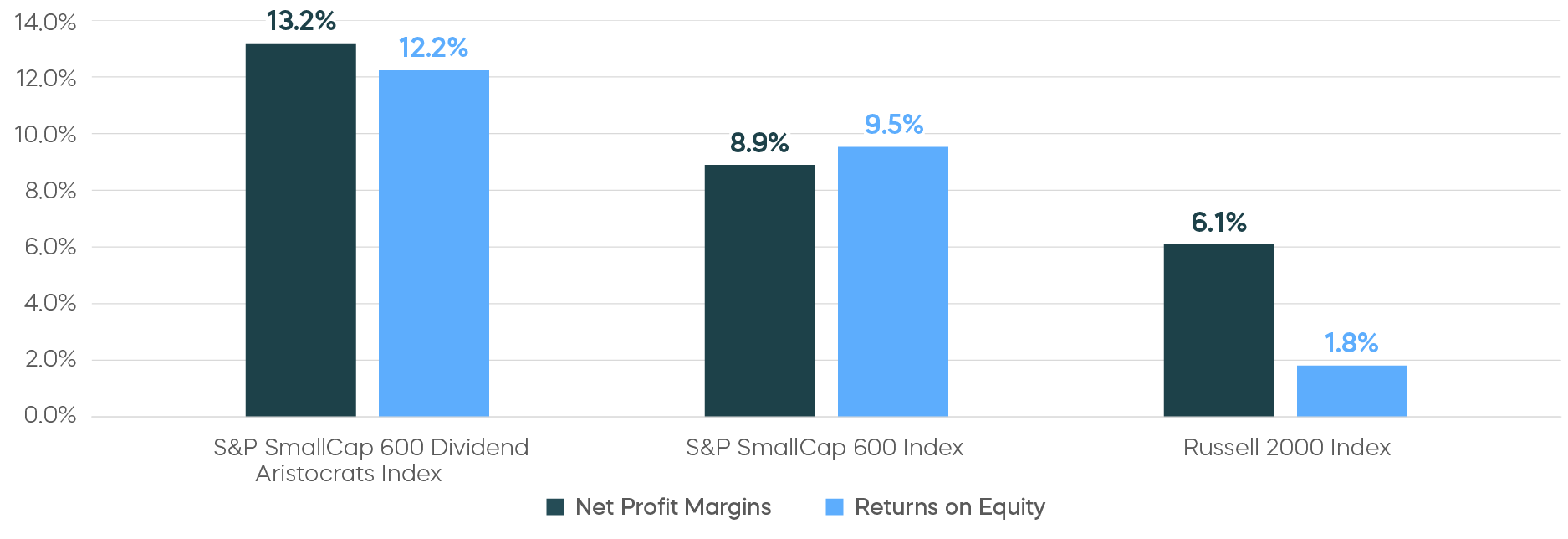
Source: FactSet. Data as of 8/31/26. Index returns are for illustrative purposes only and do not reflect any management fees, transaction costs or expenses. Indexes are unmanaged, and one cannot invest directly in an index. Past performance does not guarantee future results. Return on equity is calculated by dividing net income by average shareholders’ equity.
How can you invest in the S&P SmallCap 600 Dividend Aristocrats Index?
Investors can access the small cap Dividend Aristocrats exclusively through the ProShares S&P SmallCap 600 Dividend Aristocrats ETF (SMDV)
The bottom line
The recent small-cap rally may have long-term staying power driven by accelerating earnings growth and discounted valuations. While investing in small-caps typically involves greater risk, higher-quality small-cap stocks have historically outperformed.
The ProShares S&P SmallCap 600 Dividend Aristocrats ETF (SMDV) seeks investment results, before fees and expenses, that track the performance of the S&P SmallCap 600 Dividend Aristocrats Index, a strategy that seeks to combine the potential return opportunities of smaller companies with two meaningful quality filters: the S&P 600's financial viability requirements and a long record of consistent dividend growth.
Rather than simply owning small caps, investors gain exposure to companies that have repeatedly demonstrated an ability to grow their businesses, generate cash, and return increasing amounts of that cash to shareholders.
[1] Source: Bloomberg. Data from 5/31/25 to 9/25/26.
[2] Diversification does not ensure a profit or guarantee against a loss.
Learn More
SMDV
S&P SmallCap 600 Dividend Aristocrats ETF
Seeks investment results, before fees and expenses, that track the performance of the S&P SmallCap 600® Dividend Aristocrats® Index.